 CHOOSELY
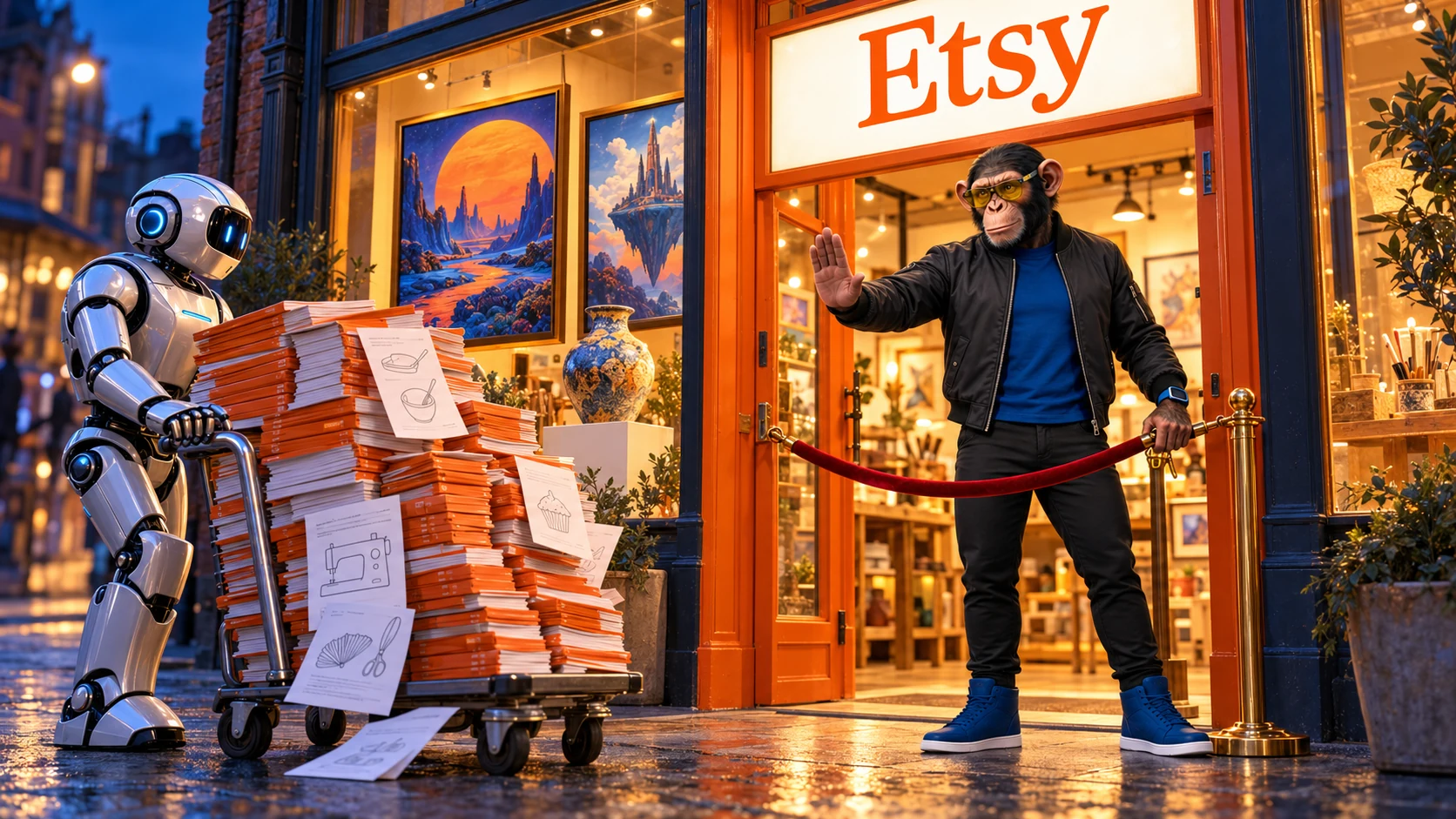
Imagine buying two digital downloads. One is a fantasy print for your wall. The other promises to teach you how to crochet the creature pictured on its cover.
You can decide whether you like the print before paying. The pattern asks for more trust. You might discover that it doesn't work only after spending an evening with a hook and a ball of yarn. The picture was convincing. The instructions were another matter.
That distinction sits at the center of Etsy's October 22 AI update. The marketplace is tightening restrictions on generated instructions, bot-only listings and misleading imagery while keeping a place for AI-assisted creativity.
For creators and buyers, the interesting question is what a seller has contributed, and whether the product can deliver what its listing promises.
When the picture is easier to make than the product
On October 9, ABC News reported on Hobart crochet artist Lucy Cooper, who developed a spiral beanie and sold its pattern on Etsy. Cooper said she later found another shop offering an AI-generated version. According to the ABC, purchasers contacted her saying the rival pattern failed to produce the beanie.
Choosely has not tested either pattern. The report predates the announcement by nearly two weeks and illustrates how a convincing listing can leave buyers disappointed.
A pattern seller is selling a route to an outcome. If that route fails, the buyer loses more than the download price. A beginner may even blame their own ability before questioning the instructions. By then, the listing has already done its job.
Why instructions face a harder line than artwork
Etsy's October 22 announcement says AI-generated functional guides, including patterns, recipes and instructions, are no longer allowed. The information buyers rely on must be the seller's own work.
The fuller AI-creations guidance also covers project plans, manuals and task-oriented guides. Etsy explains that errors can emerge after a buyer has invested time and materials. Its published wording supplies no exception for generated instructions that a seller subsequently tests.
The announcement also reaffirms permission for AI artwork with a clear creative role and an honest account of the process. Etsy's Creativity Standards require disclosure in the listing description and continue to exclude AI prompt bundles. Sellers must describe AI work accurately rather than presenting it as handmade or entirely their own creation.
For a fantasy landscape, the seller can contribute by developing the idea, directing the generator and curating the result. Working instructions face the additional authorship restriction above.
Traditional illustrators may still object to competing with generated images. Careful AI-assisted designers also have reason to want their work distinguished from an unattended output mill. Both have a stake in how Etsy applies these rules.
Five selling situations that explain the rules
The current image policy has specific exceptions. These matter more than a sweeping instruction to photograph every download.
| Situation | What the rules mean |
|---|---|
| Seller-prompted AI wall art | Eligible with the creative involvement and disclosure described above. Other Etsy rules still apply. |
| A human-written crochet pattern | Include a real, unedited photo of a result made from it. The AI-generated version of the instructions is prohibited. |
| An original design printed on a standard shirt or mug by a production partner | An authorized stock-photo mockup is permitted. Disclose the partner under Etsy's seller rules. |
| A digital download | Show a preview or excerpt. A nonvisual product, such as audio, may use representative imagery that does not mislead. A digital pattern still needs the finished-result photo. |
| An unattended system generating products and listings | Prohibited when individual human creative involvement and oversight are absent. |
Customized items made by the seller have another route: photographs of real, finished examples of their previous work. That addresses the obvious difficulty of photographing a customer's unique order before making it.
Product eligibility and listing imagery are separate requirements. The mockup allowance applies to an otherwise eligible product, and sellers using a production partner must still accurately explain who made the item.
A real photograph, with room for useful editing
For most items, Etsy requires at least one unedited photograph of the actual item against a real background. Other images can be cropped, relit or given different backgrounds, including with AI, provided they remain accurate. Removing damage or improving the apparent material would mislead the buyer.
That is where a tidy rule meets everyday photography. Value Added Resource points out that Etsy has yet to explain how it will distinguish deliberate edits from automatic camera processing or resizing.
In an r/EtsySellers discussion, participant tataniarosa welcomed the direction but said their older iPad failed to capture some thread colors accurately, making correction necessary. This individual account illustrates the tension: an unedited photograph can still misrepresent a color, while a corrected one may better match the object.
AI help is different from an unattended shop
The announcement describes the ban in terms of bot-generated listings without human involvement. The fuller guidance specifies individual human prompting, curation and creative input for each item, and prohibits mass generation without individualized oversight.
That extra detail matters when assessing a workflow. Our reading is that pressing publish alone cannot establish whether those creative requirements have been met. The reviewed guidance gives no minimum amount of involvement or complete answer for third-party listing and cross-listing tools.
Etsy itself offers some sellers optional AI assistance, including title suggestions and message drafts that people can review and change. Those tools show there is room for assistance in running a shop. Sellers still need to consider how each product was created.
Mixed instruction workflows also need clarification, particularly AI translation or substantive rewriting of a human-authored guide. Calling a step editing leaves open how much it changes the working content.
The rules have changed. Enforcement still has to prove itself.
Etsy says existing listings need updating where their images fall short. Its announcement gives no dated grace period or complete enforcement schedule.
The company describes image-upload guidance, stronger detection and a new misleading-AI-image reporting option. Initially, those reports will inform its understanding rather than trigger immediate action. More proactive enforcement and further buyer transparency are described as developing work.
Buyers should treat this as an enforcement system in development. Listings still on sale can require scrutiny.
If Etsy removes a listing, its appeal guidance directs sellers to Policy violations in Shop Manager. Availability depends on the violation; sellers without an appeal option should follow their notification email. The usual window is up to six months unless Etsy states otherwise.
Misleading images can also have a direct cost: Etsy's image policy says a seller may bear a refund when a buyer's case concerns a materially different item. That runs through the case system, separately from the new reporting option.
Choosely's take
The useful principle is what the buyer relies on. An artwork can be judged as an image; instructions make a promise about what someone can do. That is a useful question for any marketplace selling tutorials, recipes or project plans as generated content becomes easier to produce.
For buyers, start with the actual deliverable. Check the preview of a digital file and, for a pattern, the real project made from it. Read how the seller describes their contribution. Before buying a physical item, compare the plain product photograph with the styled shots, allowing for the specific exceptions above. If those leave you unsure what you will receive, ask the seller to explain it.
AI artwork should disclose its origin. Etsy also recommends noting AI edits to listing photos, which gives buyers another useful piece of context. A missing note about photo edits alone establishes little: Etsy presents that step as a best practice.
For creators, the harder test is whether Etsy can enforce the distinctions consistently and handle mistakes fairly. The marketplace has clarified what it expects. Its treatment of real shops will determine whether that restores trust.
An impressive image is an opening pitch. The product still has to earn it.
The Change Brief
Get the week’s AI changes in one clear read
Pricing moves, tool launches, free-tier changes and practical stack updates, filtered for people who actually use these tools.
Stay ahead of AI without following it all day. We’ll send you what matters each week.
Continue reading
Related reads
Product Update
Canva Built Its Own AI Image Model. What Does Craft Change for Creators?
What Canva Craft changes for creators: how it works in Dream Lab, why editable designs matter, AI allowances and when to keep another image tool.
Product Update
FLUX 3 Image Klein Explained: Can Your PC Run It, and Is It Free?
Can your PC run FLUX 3 Image Klein? Understand the 8GB claim, local setup, API pricing, commercial-use limits and whether it is worth switching.