 CHOOSELY.AI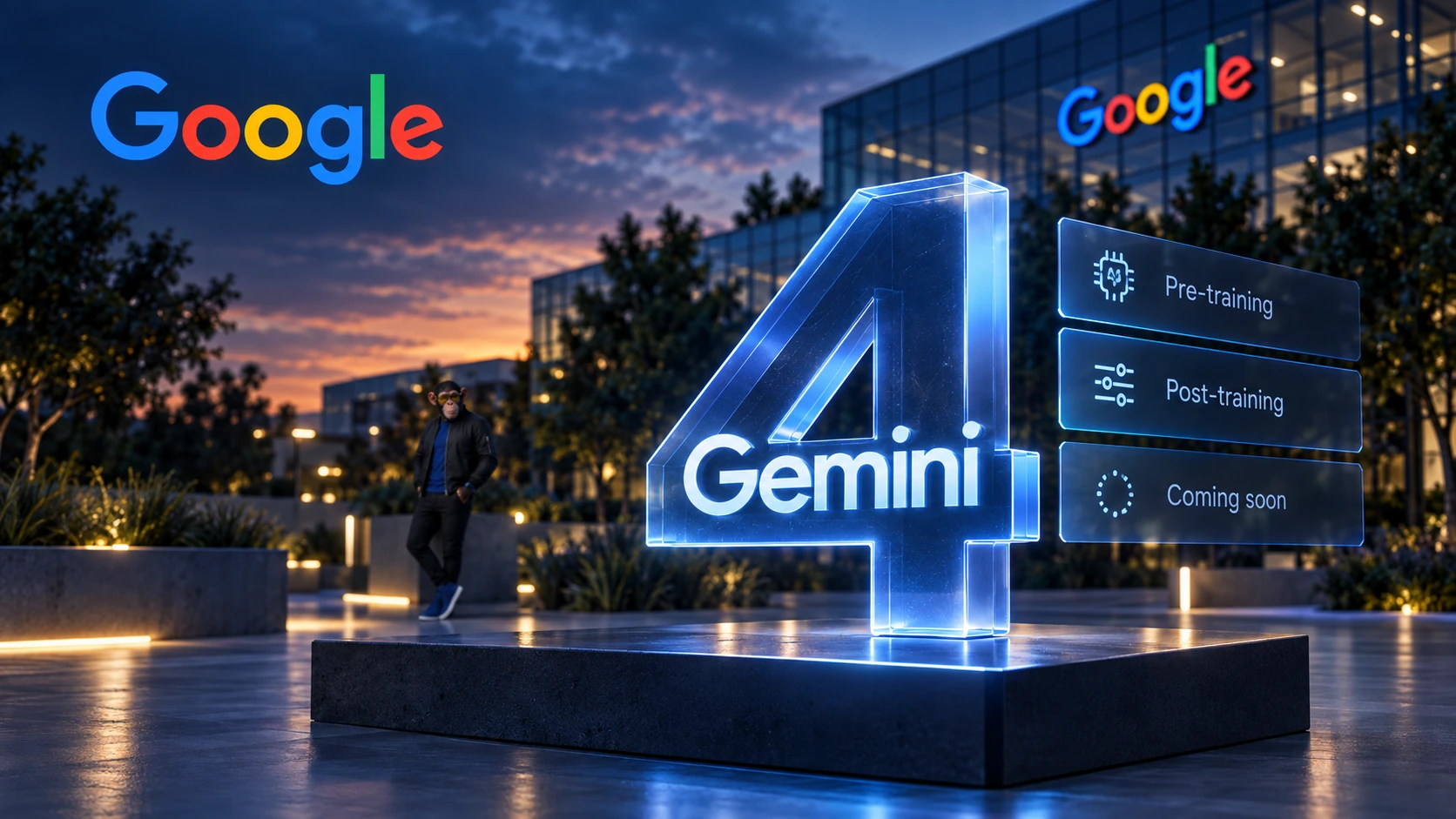
Gemini 4 is real, and it is getting closer.
Google first named its next-generation model in July, when it said it had started its "most ambitious pre-training run yet" for Gemini 4. Google's July announcement
Two months later, Google DeepMind chief Koray Kavukcuoglu said Gemini 4 had entered early post-training. He said Google wants to release an early post-training version quickly and that he hopes the model arrives "much earlier" than the end of 2026. The Information reported his remarks from AI Agenda Live.
That is the meaningful update.
What Google still has not published is almost everything people normally use to judge a frontier model: an exact release date, API model ID, pricing, context window, benchmark results, public access details or a Gemini 4 model card.
Google's current developer documentation still contains no public Gemini 4 model. Google's live Gemini API model directory remains the cleanest place to check.
Quick answer: Gemini 4 appears to be moving toward release, but there is no confirmed launch date and nowhere near enough public evidence yet to rank it against GPT-6, Claude or even Google's current Gemini models.
If you need an AI model for production today, do not build your plans around one you cannot call yet.
Gemini 4 at a glance
| Question | What we know today |
|---|---|
| Is Gemini 4 real? | Yes. Google officially named it in July 2026. |
| Current development stage | Early post-training, according to Google DeepMind's chief |
| Release date | Not announced |
| Stated timing | Google hopes for release "much earlier" than the end of 2026 |
| Public access | None announced |
| API model ID | None published |
| Pricing | None published |
| Context window | None published |
| Modalities | No Gemini 4-specific public specification |
| Official benchmarks | None published |
| Gemini 4 Pro confirmed? | No |
| Gemini 4 Flash confirmed? | No |
| Internal testing | Reportedly being tested through Google's Antigravity environment |
What Google has actually confirmed
Google's first public Gemini 4 statement came on July 21 alongside the launch of Gemini 3.6 Flash, Gemini 3.5 Flash-Lite and Gemini 3.5 Flash Cyber.
The Gemini team said it had begun its most ambitious pre-training run yet for Gemini 4 and was excited by the progress. Google's announcement also said Gemini 3.5 Pro was testing with partners and would be made broadly available when ready.
Alphabet CEO Sundar Pichai repeated the Gemini 4 point in Google's Q2 earnings remarks the following day. His prepared remarks said Google had started the Gemini 4 pre-training run and was seeing encouraging progress at the frontier.
That established two useful facts.
Gemini 4 is an official Google name, rather than something invented by the AI rumor circuit.
And in July, Google was still describing it as a training run rather than a product ready for developers.
The development status moved forward in September.
Speaking at The Information's AI Agenda Live Summit on September 23, Kavukcuoglu said Gemini 4 was in the early stage of post-training.
Reporting from the event says Google wants to release an early post-training output quickly, continue iterating, and hopes the model arrives much earlier than the end of the year. 9to5Google's report carries those remarks and the surrounding context.
Google has not published a launch date.
The useful conclusion is narrower:
Gemini 4 has progressed beyond pre-training, Google likes the results it is seeing, and its DeepMind leadership wants to get an early version out quickly.
What does post-training mean for Gemini 4?
Post-training happens after the giant pre-training run that builds the underlying model.
It is the stage where a lab refines how the system behaves, follows instructions, performs on target workloads and meets safety requirements before deployment.
Reporting around Gemini 4 says the current work includes safety testing and guardrail development.
That means the model has progressed materially.
It does not mean release is necessarily days away.
A frontier model can change considerably during post-training. Google still has to decide which checkpoint to ship, how aggressively to tune it, what safety controls are required and where the first version should appear.
The interesting part of Kavukcuoglu's comments is Google's apparent willingness to release an earlier post-training output and keep improving it rather than waiting for one final checkpoint to be considered finished.
If that happens, the first public Gemini 4 may behave more like a fast-moving preview than a model Google expects to leave untouched for months.
That remains an inference until Google publishes the actual release terms.
So when is the Gemini 4 release date?
There isn't one.
Google has not announced a day, month or launch event.
The strongest timing statement is Kavukcuoglu's hope that Gemini 4 arrives "much earlier" than the end of 2026, alongside the stated intention to release an early output as soon as possible.
That makes a 2026 release a stated ambition. It does not give users a date to plan around.
Specific October, November and other release windows are circulating online. None is currently an official Google launch date.
This distinction matters:
Google wants Gemini 4 out quickly. That is supported.
A specific October or November launch date is not currently confirmed by Google.
A September 28 follow-up report still described Gemini 4 as being in post-training with no announced release date. The Next Web's report did not identify a newer Google timetable.
Gemini 4 pricing is still unknown
There is no official Gemini 4 pricing.
Google's current Gemini API pricing documentation covers models developers can actually use today. It has no Gemini 4 pricing section.
That means there is no confirmed Gemini 4:
- input-token price
- output-token price
- cached-input price
- batch rate
- long-context rate
- free-tier allowance
Specific Gemini 4 prices circulating online should not be used for budgeting.
Google could price the model close to its existing Gemini lineup, charge more for a new flagship, introduce different rates for very long context or use temporary introductory pricing.
There is recent precedent for temporary pricing. Google is currently offering introductory rates on parts of its Flash lineup before higher standard rates take effect.
None of that tells us what Gemini 4 will cost.
For developers choosing an API today, the useful price is still the price of the model they can actually call.
There is no confirmed Gemini 4 context window either
The same rule applies to context.
Claims about enormous Gemini 4 context windows have circulated online, including multi-million-token figures.
Google has not published a Gemini 4 context specification.
Its current model directory documents the token limits and capabilities of public Gemini models. There is no Gemini 4 entry to read from.
The same applies to modalities.
It is reasonable to expect Google's next frontier Gemini generation to remain highly multimodal given the rest of the family.
Expectation is not specification.
Until Google documents Gemini 4's supported text, image, audio or video inputs, those details remain unknown.
Agents may be the more important clue
One development signal is worth watching closely.
The Information reported that Gemini 4 is already being used in internal testing through Google's Antigravity environment. 9to5Google also reported the internal testing.
That fits Google's broader direction.
Gemini 3.6 Flash was launched around production agents, coding, computer use and multi-step workflows. Choosely covered those changes when the model launched.
Internal use still tells us little about how well Gemini 4 performs.
We do not know the exact model configuration being tested, whether the results resemble the version that will eventually ship, or how those results compare with competing frontier models.
The narrower signal is useful:
Google appears to be exercising Gemini 4 on work that requires models to act, not merely chat.
What happened to Gemini 3.5 Pro?
This is where Google's model sequence gets slightly messy.
In July, Google said Gemini 3.5 Pro was testing with partners and would be made broadly available when ready. That was the same announcement that revealed Gemini 4 pre-training had begun. Google's July post is the primary record.
Gemini 3.5 Pro still does not appear in Google's public API model list.
Google has instead continued advancing its Flash line. The current Gemini model directory lists Gemini 3.8 Flash as a Stable model while Gemini 3.1 Pro remains Preview.
Kavukcuoglu said in September that Google had taken a step back from the 3.5 Pro effort to focus on Flash models and that Gemini 4 is now the flagship focus. 9to5Google reported those remarks.
He did not say Gemini 3.5 Pro had been cancelled.
There is no reason to manufacture a cleaner roadmap than Google has provided.
Gemini 4 is the flagship to watch. Gemini 3.5 Pro's eventual fate remains unresolved.
For another recent Gemini capability change, see Choosely's Gemini 3.8 Live Avatar analysis.
Gemini 4 vs GPT-6: there is no honest comparison yet
"Gemini 4 vs GPT-6" will almost certainly become a major search.
Right now, it is not a comparison Choosely can make responsibly.
OpenAI has released GPT-6 Astra with a public model ID, published pricing, documented context limits and benchmark material.
Gemini 4 has none of those things publicly available.
Choosely's GPT-6 Astra analysis examines the released model and the evidence behind its headline benchmark claims.
Putting Gemini 4 and GPT-6 into a performance table today would mean filling one side with measurements and the other with rumors.
Alleged Gemini 4 screenshots, arena sightings and informal output comparisons may be useful leads. They cannot establish repeatable performance while the public model is unavailable and its configuration cannot be independently reproduced.
The useful Gemini 4 vs GPT-6 article comes after Google releases enough information to test the comparison properly.
Until then, there is not enough evidence.
Should you wait for Gemini 4?
For most people, no.
If your current Gemini, Claude or ChatGPT setup is doing the job, an upcoming model announcement is not a reason to freeze your workflow.
Google's current documentation lists Gemini 3.8 Flash as a Stable model and Gemini 3.1 Pro as Preview. Check the current model directory before choosing either.
If you use Gemini now, the Google Gemini profile on Choosely provides the current tool-level reference.
Businesses should treat Gemini 4 as an upcoming evaluation event rather than something they need to design around before it exists.
A sensible approach is to:
- keep model names configurable rather than hard-coding them throughout an application
- preserve a small set of real tasks you can rerun against a new model
- record current quality, latency and cost
- compare Gemini 4 once Google publishes a public model and pricing
- switch only if the improvement matters for your workload
For a broader current-model decision, see Which AI Model Should You Use in 2026?.
The launch announcement is where the Gemini 4 evaluation starts.
What would confirm that Gemini 4 has actually launched?
Ignore the screenshot race.
For developers, the clearest signals will be fairly boring:
- 1Gemini 4 appears in Google's official model documentation.
- 2Google publishes a callable model ID.
- 3Gemini 4 appears on the official pricing page.
- 4Google documents context limits, modalities and availability.
- 5A launch post or model card explains what Google is actually claiming.
As of September 29, those pieces are still missing.
Google's API Release Notes also contain no Gemini 4 release entry at publication time.
Once those pieces appear, Gemini 4 stops being a roadmap story and becomes something Choosely can actually assess.
The Choosely verdict
Gemini 4 is no longer a distant pre-training project.
Google DeepMind says it has moved into early post-training. Its leadership wants an early version released quickly, and internal agent-oriented testing is reportedly underway.
That is enough to take the release seriously.
It is not enough to fill in the blanks.
There is still no confirmed Gemini 4 release date, pricing, context window, API model ID or benchmark package. There is also no defensible Gemini 4 vs GPT-6 verdict yet.
Watch the documentation, not the rumor clock.
Keep using the best current model for the work in front of you. When Gemini 4 becomes a real callable product, test it against your actual workload and make the switching decision from evidence.
Frequently asked questions
Is Gemini 4 released?
No. Google has confirmed Gemini 4 is in development, and Google DeepMind's chief says it has entered early post-training. As of September 29, 2026, Google's public Gemini API model directory does not list a Gemini 4 model.
What is the Gemini 4 release date?
Google has not announced one. Google DeepMind leadership says it wants an early post-training version released quickly and hopes Gemini 4 arrives "much earlier" than the end of 2026.
Is Gemini 4 Pro confirmed?
No. Google has confirmed the Gemini 4 name. "Gemini 4 Pro" has appeared in leaks and speculation, but Google has not announced a public product under that name.
How much will Gemini 4 cost?
Google has not published Gemini 4 pricing. Figures circulating online are not part of Google's current official pricing documentation.
Does Gemini 4 have a 10-million-token context window?
There is no official Gemini 4 context-window specification today. Google's public model directory contains no Gemini 4 entry.
Is Gemini 4 better than GPT-6?
There is not enough public evidence to know. GPT-6 Astra can be tested as a released model. Gemini 4 cannot yet be independently tested as a public product.
Should developers wait for Gemini 4?
Usually not. Build against a released model that meets the current requirement, preserve an evaluation set, and test Gemini 4 once Google publishes a real endpoint, pricing and specifications.
Keep your Gemini stack current
Gemini itself is still changing quickly, and Gemini 4 will add another decision once it actually becomes available.
Choosely Stack Intelligence helps keep the AI tools you rely on visible as models, pricing, access and capabilities change.
The Change Brief
Get the week’s AI changes in one clear read
Pricing moves, tool launches, free-tier changes and practical stack updates, filtered for people who actually use these tools.
Stay ahead of AI without following it all day. We’ll send you what matters each week.
Continue reading
Related reads
Product Update
Gemini 3.8 Live Avatar Gives AI Agents a Face. The Limits Matter More Than the Demo.
Live Avatar is enterprise-focused. Custom avatars are gated. Google says continuous avatar interactions currently last a few minutes rather than hours.
Product Update
Gemini 3.6 Flash Cuts Agent Costs: The AI Tool Changes That Matter This Week
Google's new Gemini Flash tiers sharpen the economics of production agents, while Kimi K3, Grok's Microsoft 365 add-ins and OpenAI Presence move capable models deeper into real work.
AI Strategy
GPT-6 Astra Explained: What the 99.9% ARC-AGI-3 Score Really Means
GPT-6 Astra makes a huge leap in adaptive reasoning and agentic work, but its viral 99.9% ARC-AGI-3 result depends on a provider-specific context-management harness.
AI Tool Recommendations
Which AI Model Should You Use? A Simple Guide to Fast, Thinking and Pro Modes
Start with the normal model and its default reasoning level, then escalate when the task gives you a reason to. A practical guide to Instant, Thinking, effort levels and Pro modes across ChatGPT, Claude and Gemini.
Sources
- Google, July 21, 2026: Gemini 3.6 Flash, Gemini 3.5 Flash-Lite and Gemini 3.5 Flash Cyber announcement
- Google / Alphabet, July 22, 2026: Q2 2026 remarks from Sundar Pichai
- Google AI for Developers: Gemini API Models
- Google AI for Developers: Gemini API Pricing
- Google AI for Developers: Gemini API Release Notes
- The Information, September 23, 2026: Google Nears Release of Flagship Gemini 4 AI Model
- 9to5Google, September 24, 2026: Google says Gemini 4 release is coming "as soon as possible"
- The Next Web, September 28, 2026: Google wants Gemini 4 out "much earlier" than the end of the year