 CHOOSELY.AI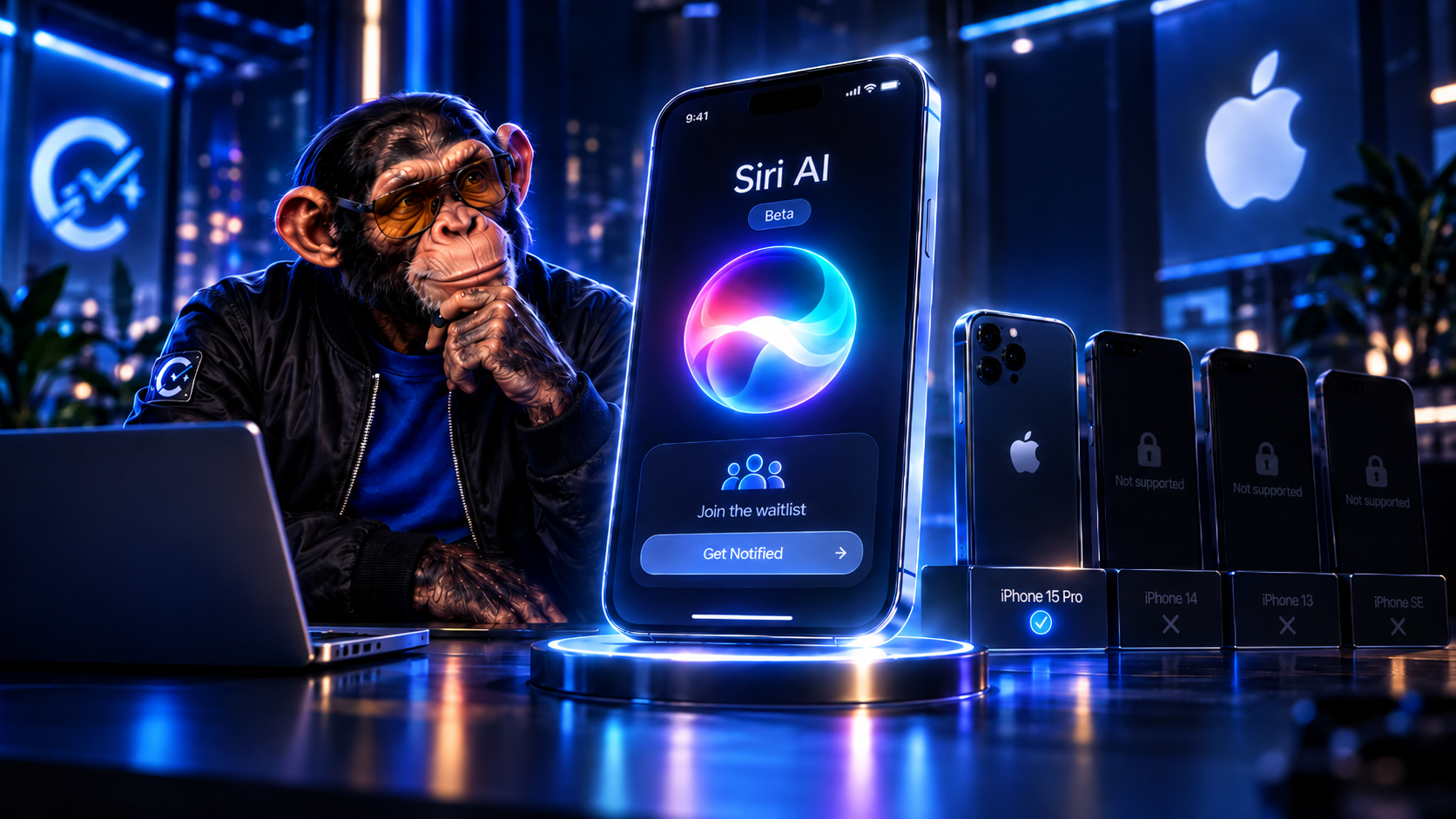
Apple’s biggest Siri upgrade in years has arrived with iOS 27, but installing the update does not automatically unlock it. Siri AI is rolling out through a waitlist, requires newer hardware, and even some compatible iPhones miss its best voice features. Here is what actually matters.
If you updated to iOS 27 expecting Siri to suddenly become much smarter, you may have opened Settings and wondered whether anything changed.
That does not necessarily mean your update failed.
Apple released Siri AI on September 14, 2026, but access is being granted separately through a gradual beta rollout. On a compatible iPhone, go to Settings → Siri → Try Siri AI (Beta) and join the waiting list. Apple will notify you when access is ready, and the dedicated Siri app appears automatically once you are approved.
There is another catch that will confuse plenty of people: iOS 27 supports far more iPhones than Siri AI does.
iOS 27 runs on the iPhone 11 generation and newer, including the second-generation iPhone SE. Siri AI requires Apple Intelligence hardware, which starts with the iPhone 15 Pro and 15 Pro Max.
So yes, you can have the latest version of iOS and still have the old Siri.
How to get Siri AI on iOS 27
If you just want the new Siri, the setup is straightforward:
- 1Update to iOS 27.
- 2Open Settings.
- 3Tap Siri.
- 4Tap Try Siri AI (Beta).
- 5Follow the prompts and join the waiting list.
Apple’s current setup guide confirms the same activation path. Apple says Siri AI is rolling out gradually rather than switching on for everybody at once. Current user reports range from approvals within minutes to waits of several hours or even days, so there is no reliable standard waiting time yet.
Once access is granted, you can activate Siri AI in several ways. You can still say “Siri” or “Hey Siri,” press and hold the side button, open the dedicated Siri app, or use one of the new gestures: swipe down from the Dynamic Island.
Choosely rollout check
Choosely installed iOS 27 and joined the public Siri AI waitlist from Sydney on September 16. At the time this article was prepared, access had not yet been granted.
That is only one real-world observation, not a meaningful estimate of general wait times. We will update this article once access arrives and add a short hands-on check.
Which iPhones support Siri AI?
This is the part worth checking before repeatedly restarting your phone.
Apple’s current Apple Intelligence compatibility list includes the following iPhones:
| iPhone | Siri AI |
|---|---|
| iPhone 15 | No |
| iPhone 15 Plus | No |
| iPhone 15 Pro | Yes |
| iPhone 15 Pro Max | Yes |
| iPhone 16e | Yes |
| iPhone 16 | Yes |
| iPhone 16 Plus | Yes |
| iPhone 16 Pro | Yes |
| iPhone 16 Pro Max | Yes |
| iPhone 17e | Yes |
| iPhone 17 | Yes |
| iPhone Air | Yes |
| iPhone 17 Pro | Yes |
| iPhone 17 Pro Max | Yes |
| iPhone 18 Pro | Yes |
| iPhone 18 Pro Max | Yes |
| iPhone Duo | Yes |
That means an iPhone 11, 12, 13, 14, standard iPhone 15 or iPhone 15 Plus can install iOS 27 without getting Siri AI. Apple’s software support window and its AI hardware requirements are now two different things.
For anyone buying an iPhone specifically for Siri AI, do not simply ask whether the phone runs iOS 27. Ask whether it supports Apple Intelligence.
There is also a second hardware tier
Even among Siri AI-compatible iPhones, not every device gets every feature.
Apple’s more advanced on-device model, called AFM 3 Core Advanced, powers the new adjustable Siri voice pace and expressiveness plus more capable systemwide dictation. Apple’s September launch documentation lists these iPhones as supporting the advanced model:
- iPhone Duo
- iPhone 18 Pro
- iPhone 18 Pro Max
- iPhone Air
- iPhone 17 Pro
- iPhone 17 Pro Max
Apple’s current official sources conflict specifically on iPhone Duo. The September launch documentation lists Duo among devices using AFM 3 Core Advanced, including expressive voices and advanced dictation. However, Apple’s current iPhone support guide omits Duo from its separate Siri Expressive Voices compatibility list. Until Apple reconciles those pages, Choosely is treating expressive-voice support on Duo as unclear.
The iPhone 17, 17e, 16-series phones and iPhone 15 Pro models still get Siri AI. They just do not get this higher-end voice and dictation layer.
For most buyers, this should not determine the entire phone purchase. But if Apple’s more natural voice interaction or improved dictation is a major reason you are upgrading, the distinction matters.
What is actually new about Siri AI?
The old Siri was perfectly capable of setting a timer, calling somebody or telling you whether it would rain.
Ask something complicated and the wheels often came off quickly.
Siri AI is designed to behave much more like the AI assistants people have become accustomed to using elsewhere. Apple says it now has broader world knowledge, can maintain a conversation, understand what is on your screen, use personal context from your apps, and perform more actions across the device.
In normal language, that means Siri can potentially help with questions such as:
“Where was that restaurant Sarah sent me?”
It can use personal context from Messages.
Or:
“What time is Mum’s flight?”
It can surface relevant information from your email or other apps.
If you are looking at class notes, a chart or two documents on screen, you can ask Siri to explain what you are seeing or compare the information. Apple specifically demonstrates asking Siri which of two reports grew faster without first copying everything into another app.
That is a much more useful version of Siri than another prettier animation.
Siri finally keeps the conversation
iOS 27 also introduces a dedicated Siri app.
Your Siri AI conversations can be revisited instead of disappearing after each request, and Apple says conversational history can sync through iCloud across supported Apple devices.
That will feel completely ordinary to anyone who already uses ChatGPT, but it is an important philosophical change for Siri.
Siri used to feel like a collection of individual commands. Apple now wants it to feel like an ongoing assistant that remembers where the conversation was going.
Siri can understand what is on your screen
One of the more immediately useful upgrades is onscreen awareness.
With Siri AI active, you can ask about information already visible on your iPhone rather than explaining it from scratch. Apple gives examples including asking Siri to explain a diagram in your notes or comparing two reports selected in Files.
Visual Intelligence also extends into the Camera app. Siri mode can identify something in front of you, answer questions about it and surface relevant actions. Apple even gives the example of pointing the camera at a restaurant bill and using a suggested action to split it.
For everyday users, this could matter more than whatever benchmark Apple’s AI model scores next.
Removing the friction of copying information between apps is exactly the sort of boring improvement that makes an assistant genuinely useful.
Writing Tools and Write with Siri
Apple has two related writing experiences, and the naming is slightly confusing.
Writing Tools already lets Apple Intelligence users rewrite, proofread and summarize text across many apps and websites. With Siri AI enabled, Write with Siri adds the ability to generate a draft from scratch, rewrite text, proofread it and give feedback conversationally.
That covers very ordinary jobs:
- draft an email
- improve an awkward message
- shorten a paragraph
- proofread something
- change the tone
- summarize meeting notes
None of those capabilities is novel in 2026.
The difference is distribution.
Millions of people who would never deliberately open an AI writing tool already know how to invoke Siri.
Is Siri AI basically ChatGPT inside the iPhone?
No.
Siri AI is Apple’s system-level assistant, built around Apple Intelligence and integrated deeply into iPhone, Messages, Mail, Photos, Camera, Calendar and other parts of the operating system.
Apple says its next-generation models were developed in collaboration with Google and Gemini technology, with work split between on-device processing and Apple’s Private Cloud Compute infrastructure.
For a normal user, the more important distinction is simpler.
ChatGPT is a destination. Siri is part of the phone.
ChatGPT remains better suited to many longer research tasks, specialist workflows, file-heavy work and broad AI tooling. Siri’s advantage is that it can potentially understand what is already happening across your device and take actions there without requiring you to manually move the information somewhere else.
Apple does not need Siri to win every intelligence benchmark if it becomes the assistant that can find the flight confirmation buried in your email and actually do something useful with it.
Siri AI has usage limits
This is one of the less glamorous parts of the launch.
Apple says certain Apple Intelligence features that rely on server-side models are subject to daily usage limits. Siri AI is included, but the policy also covers features such as intelligent photo editing, Image Playground and AFM 3 Cloud models used through Shortcuts.
Apple has not published a simple allowance such as “50 Siri requests per day.”
Instead, it says limits can vary based on the feature being used, request complexity, system demand, system policies and other factors.
That makes the experience harder to predict than a traditional fixed allowance.
Apple also says expanded access will be available for a fee in the future. Earlier Apple launch material connected increased access for some Apple Intelligence features with iCloud+ plans, although Apple has not published final Siri AI pricing in its current launch documentation.
So Siri AI is free to start, but Apple is already laying the groundwork for heavier AI usage to become part of a paid services relationship.
That deserves watching.
How long does the Siri AI waitlist take?
Apple does not give a fixed answer.
The company says Siri AI is rolling out gradually, while current reports suggest some users are receiving access within minutes and others are waiting hours or days.
That means there is currently no reliable trick to speed it up.
Join the waiting list, keep the phone connected normally and wait for Apple’s notification.
If TikTok tells you to change your region twelve times, reboot three times and face Cupertino while holding the side button, perhaps give the official rollout a chance first.
Is Siri AI available in Australia?
Yes.
Apple’s Australian site lists the new Apple Intelligence hardware and has begun rolling Siri AI out in English as part of the iOS 27 release.
The initial Siri AI beta is English-only, with French, Japanese, Korean, Portuguese and Spanish scheduled to arrive in October.
Australia therefore avoids one of the bigger launch restrictions affecting Europe and China.
Why is Siri AI not available on iPhone in the EU?
Apple says Siri AI is not initially available on iOS, iPadOS or watchOS in the European Union, and says it is trying to find a path forward that preserves privacy and security. Mac and Vision Pro are not subject to the same initial block.
There is an important disagreement over why.
The European Commission says the Digital Markets Act does not prevent Apple from launching Siri AI in Europe. Its position is that Apple can ship the product as long as competing services receive the required interoperability access. The Commission says the decision not to roll it out on those platforms is Apple’s own.
That dispute is not going away quietly.
For consumers, the practical result is simpler: supported iPhone owners in the EU currently do not get Siri AI even if their hardware can run it.
What happens to all the personal information Siri can now see?
A Siri capable of finding information across your messages, email, photos and calendar is much more useful.
It is also much more sensitive.
Apple’s answer is a privacy architecture that tries to keep as much work as possible on the device. More demanding requests can use Private Cloud Compute, where Apple says personal data is used only to process the request, is not stored and is not accessible to Apple.
You do not need to understand the server architecture to understand the trade-off.
Siri AI becomes useful because it understands more about your personal world.
Choosely still recommends checking permissions rather than granting every app and data source access simply because the setup screen asks nicely.
Convenience is not a reason to stop reading permission prompts. For a wider framework, see Choosely’s guide to permissions for always-on AI assistants.
The bigger privacy question may be coming to Apple Watch
Siri AI’s ability to search Messages is not actually Apple’s most provocative new AI feature.
Later in 2026, Apple plans to launch Live Rewind and Siri Recap on Apple Watch Series 12 and Apple Watch Ultra 4.
Live Rewind lets the wearer double-press the Digital Crown and see the previous 15 seconds of a conversation as text. Siri Recap can generate high-level summaries of conversations and place them inside the Siri app.
That sounds considerably more intimate than searching an email.
Apple has built substantial privacy controls around these features. Audio first enters a protected hardware buffer in the Apple Watch S11 Secure Exclave. Live Rewind is processed on-device, while Siri Recap securely passes encrypted audio to the paired iPhone, where it is transcribed and condensed before an encrypted condensed text representation, not the original audio, is sent to Private Cloud Compute to create the summary. Apple says the original audio is not recorded or stored, and data processed in Private Cloud Compute is not accessible to Apple.
Live Rewind produces an audible chime even when the watch is muted and displays a visible recording indicator. Apple also says Siri Recap does not identify individual speakers and is designed to exclude sensitive data such as financial information and government identifiers. Saved summaries and Live Rewind snippets can sync through iCloud with end-to-end encryption.
Those protections matter.
So does the underlying idea.
A watch that can help you remember what somebody said 15 seconds ago is genuinely useful. A watch capable of generating summaries of real-world conversations will also force Apple to explain where helpful memory assistance ends and ambient AI begins.
That may become the more interesting privacy debate later this year.
Is Siri AI worth using?
For anyone with compatible hardware, yes.
Apple has finally addressed several things that made Siri feel years behind modern AI assistants. It can sustain conversations, understand more personal context, reason about what is visible on screen, answer broader questions and perform more useful actions across the device.
But this is still a beta.
Access is being throttled through a waiting list. Server-powered capabilities have variable daily limits. The most advanced voice and dictation features require newer hardware. Apple itself says more capability and wider language support are still coming.
This should be treated as the beginning of the new Siri, not the finished product.
Apple arrived late, but it arrived with an advantage
Apple did not teach the world how to speak to an AI assistant.
ChatGPT and its rivals already did that.
People now expect to ask follow-up questions, write naturally, upload information and receive something more useful than a web search result. Siri spent years falling behind those expectations.
Apple’s advantage is that Siri already owns the front door to hundreds of millions of devices.
If Siri becomes genuinely good at understanding your messages, your photos, your calendar and what is happening on your screen, the competition stops being only about which model produces the smartest paragraph.
Sometimes the best assistant is simply the one that already has the right context and permission to do something useful.
That is the bet behind Siri AI.
Choosely verdict
Siri AI is the upgrade Siri badly needed.
For ordinary iPhone users, the most important improvements are easy to understand: Siri can hold a proper conversation, find information across your personal apps, understand what is on your screen and perform more useful actions without making you manually move everything between apps.
The rollout is less elegant.
You need compatible hardware, iOS 27, English for the initial beta and, for now, a place through Apple’s waiting list. Even then, the newest iPhones get capabilities that older Siri AI-compatible models do not, and Apple has already confirmed variable daily limits and future paid access for heavier use.
So if you installed iOS 27 and wondered where the futuristic Siri went, your phone probably is not broken.
Apple shipped the new Siri with a queue at the door.
Once that door opens, this is the first version in years that looks capable of changing how normal people actually use Siri.
Keep your AI stack from going stale
Siri AI is one more reason to keep an eye on which assistants are earning access to your work and personal context. Choosely’s Stack Intelligence keeps saved tools and workflows visible when models, limits, access or pricing materially change.
Save the AI tools you rely on in Choosely
FAQ
How do I get Siri AI on iOS 27?
Open Settings → Siri → Try Siri AI (Beta) on a compatible iPhone and follow the prompts. Apple currently uses a gradual waiting-list rollout, and you will receive a notification when access is available.
Why don’t I have Siri AI after installing iOS 27?
iOS 27 itself supports iPhone 11 and newer, but Siri AI requires an Apple Intelligence-compatible iPhone. You also need a supported language and access through the current beta rollout.
Which iPhones support Siri AI?
Siri AI works on iPhone 15 Pro and 15 Pro Max, the full iPhone 16 family including 16e, iPhone 17e, iPhone 17, iPhone Air, iPhone 17 Pro and Pro Max, iPhone 18 Pro and Pro Max, and iPhone Duo.
Does the standard iPhone 15 get Siri AI?
No. The iPhone 15 and 15 Plus can run iOS 27 but do not support Apple Intelligence or Siri AI.
How long does the Siri AI waitlist take?
Apple gives no fixed time. Current reports range from a few minutes to several hours or days. Choosely joined the waitlist in Sydney and had not received access at the time of publication.
Is Siri AI free?
Siri AI is included on supported hardware, but some server-powered Apple Intelligence features have daily limits. Apple says expanded access will be available for a fee in the future. Earlier Apple launch material connected increased access for some Apple Intelligence features with iCloud+ plans, but final Siri AI pricing has not been published.
Is Siri AI available in Australia?
Yes. Siri AI is rolling out in English on supported Apple Intelligence devices in Australia.
Is Siri AI available in the EU?
Not initially on iPhone, iPad or Apple Watch. Apple and the European Commission disagree over the role of the Digital Markets Act in the delay.
Can Siri AI read my messages and emails?
Siri AI can use personal context from apps such as Messages, Mail, Photos and other supported services to help answer requests. Apple says sensitive cloud processing uses Private Cloud Compute and that request data is not stored or made accessible to Apple.
Is Siri AI the same as ChatGPT?
No. Siri AI is Apple’s system-level assistant, integrated into Apple devices and apps. ChatGPT is a separate general-purpose AI assistant with a different set of tools and workflows.
The Change Brief
Get the week’s AI changes in one clear read
Pricing moves, tool launches, free-tier changes and practical stack updates, filtered for people who actually use these tools.
Stay ahead of AI without following it all day. We’ll send you what matters each week.
Continue reading
Related reads
AI Strategy
The Always-On AI Assistant Is Here. What Should You Actually Let It Do?
Persistent AI assistants can remember, act and continue working after the prompt ends. The real product decision is how much authority they should receive.
AI Tool Recommendations
ChatGPT Voice vs Claude Voice: Which One Should You Actually Talk To?
ChatGPT Voice is the stronger documented fit for fluid everyday conversation, while Claude Voice stands out for model choice and connected productivity tools.
AI Tool Recommendations
ChatGPT Work vs Claude Cowork: Which AI Work Agent Should You Actually Pay For?
ChatGPT Work and Claude Cowork can both research, use files and connected tools, and return finished professional deliverables. The better choice depends on where your work begins and what you need back.