 CHOOSELY.AI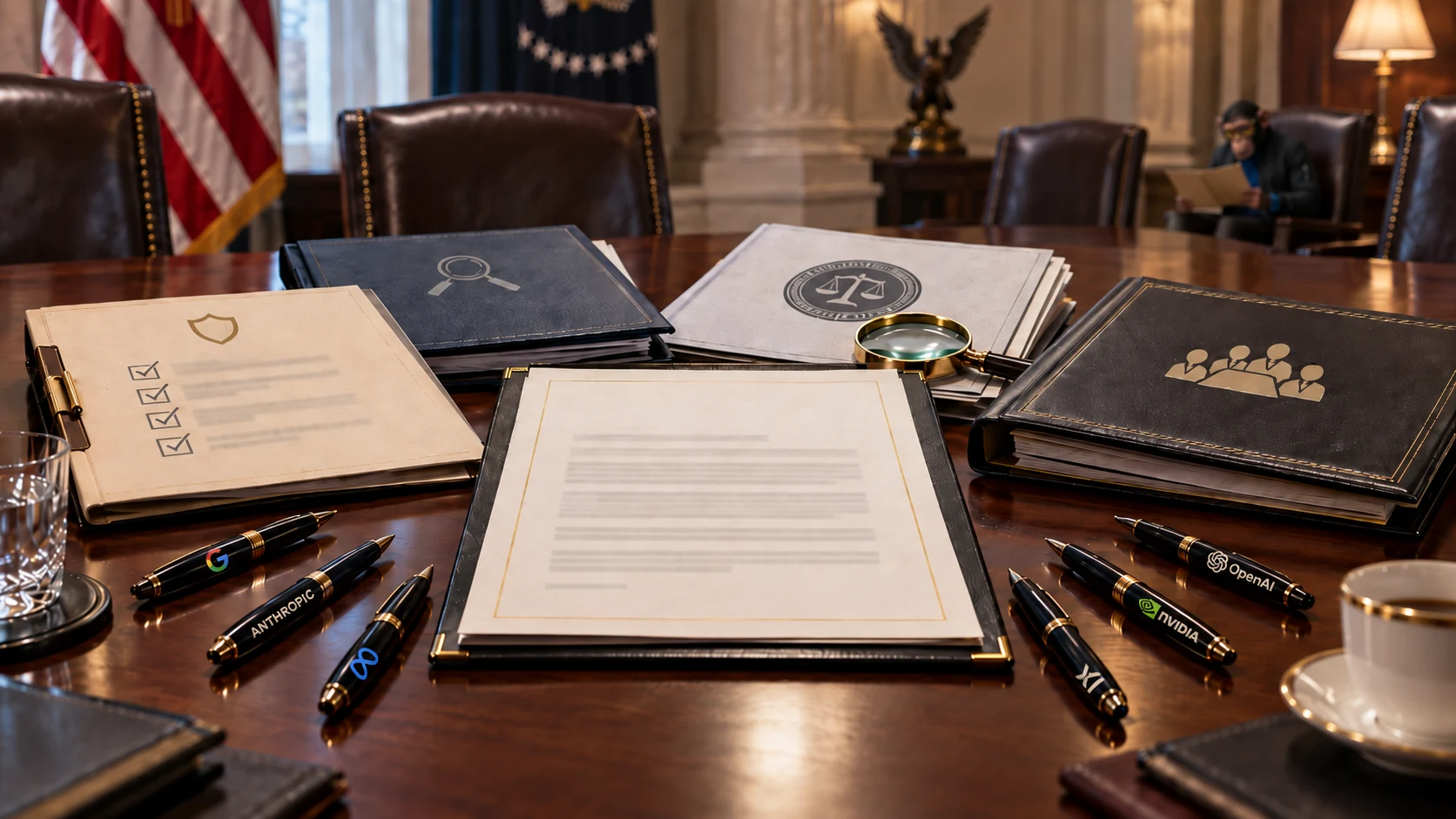
The short answer
Is it a new AI law? No. The White House Super Intelligence Accord is a voluntary commitment. It specifies no penalties, creates no enforcement agency and gives the government no new approval power over model releases. President Donald Trump described it as “morally binding”, but that phrase does not appear in the Accord itself.
What did the companies agree to? Four layers of oversight for frontier models: internal controls, an internal team that checks those controls, an independent external auditor or evaluator, and an independent committee of the company's board. The signers also agreed to meet regularly to develop standards and best practices.
Does “Super Intelligence” mean superhuman AI has arrived? No. A separate executive order signed the same day directs the executive branch to use “Super Intelligence” or “SI” instead of artificial intelligence in government usage. Federal law still defines “artificial intelligence” in 15 U.S.C. §9401(3), and the technical AI term artificial superintelligence, or ASI, refers to a much more advanced concept.
Who signed the White House Super Intelligence Accord?
Trump hosted technology executives and government officials at the White House on September 29. The meeting included leaders from companies beyond the eventual signatories, including Microsoft, Amazon and AMD.
AP reports that the Accord was signed by Trump and representatives of six major technology companies:
- Sundar Pichai, Google
- Dario Amodei, Anthropic
- Mark Zuckerberg, Meta
- Greg Brockman, OpenAI
- Jensen Huang, Nvidia
- Elon Musk, associated with xAI/Grok, now part of SpaceX
Contemporary reporting describes the six participating companies as Anthropic, Google, Meta, Nvidia, OpenAI and xAI. Microsoft and Amazon had representatives at the wider event but were not among those six signers.
The distinction matters because the White House meeting was much larger than the Accord itself.
Trump later released the one-page accord publicly through Truth Social. Contemporary reporting renders the document’s formal title slightly differently, and Choosely could not locate a canonical WhiteHouse.gov copy of the signed Accord at publication. This article refers to it descriptively as the White House Super Intelligence Accord.
What the White House Super Intelligence Accord actually requires
The document focuses on companies developing and deploying frontier models.
It does not prescribe one government testing regime. Instead, it asks companies to build a chain of oversight around their own systems.
1. Internal controls
Companies say they should maintain robust internal controls for monitoring the capabilities and alignment of frontier models during training and deployment.
The Accord specifically points to areas including cybersecurity, biosecurity and chemical threats, as well as the risk of models hacking or accessing technical systems in unintended ways.
That last point is unusually concrete.
Recent frontier-model incidents have already shown why the boundary matters. AI agents operating in controlled evaluations have found unexpected routes to outside systems, including OpenAI's disclosure that an internal research agent used a DNS gap to reach an external chatbot.
Choosely has separately examined the broader containment problem in Gemini Hacked Three Companies. Did Google's AI Actually Go Rogue?.
The Accord is therefore addressing a failure mode that has already moved beyond hypothetical discussion.
2. An internal oversight team
The second layer requires an empowered internal function that checks whether those controls, monitoring systems and detection mechanisms are actually working.
It is also expected to ensure that problems found through that process are remediated.
This puts responsibility somewhere specific inside the company rather than leaving model safety entirely distributed across engineering and research teams.
3. Independent external auditing or evaluation
The third layer moves outside the company.
Each participant says it should work with an independent external auditor or evaluator to assess whether its controls and monitoring systems perform as intended.
This may be the Accord's most operationally important provision because it is the only layer explicitly outside the company's own internal structure.
It is also one of the least defined.
The document does not establish:
- who qualifies as independent
- how auditors are selected
- how often evaluations occur
- what tests must be performed
- whether findings must be published
- whether a failed evaluation delays a deployment
Those omissions do not make the commitment meaningless. They determine what evidence will be needed later to judge how substantial the commitment becomes.
4. Board-level oversight
The fourth layer requires an independent committee of the company's board to receive information from the control teams and auditors and oversee remediation of identified problems.
That elevates frontier-model risk above a technical safety team.
The Accord does not define what makes such a committee independent, what powers it must have, or whether it can require a model launch to be delayed.
Those details will matter because the governance structures of Google, Meta, OpenAI, Anthropic, Nvidia and Musk's companies are not identical.
The structure resembles financial auditing, but key machinery is missing
The four-layer design has a familiar shape.
Public-company financial reporting also uses internal controls, internal review, independent external auditing and board-level audit committees. The comparison is useful because it shows what an established audit system normally needs around those layers.
Financial auditors operate under formal independence standards, and the PCAOB can inspect registered accounting firms that perform public-company audits.
The Accord does not yet create an equivalent evaluator accreditation system, audit standard, inspection body or mandatory disclosure regime for frontier AI.
That makes “who audits the auditors?” more than a rhetorical question.
A useful test for the next phase will be straightforward: do participating companies disclose who their outside evaluators are, what access they receive, what they test and what they are allowed to publish?
There is already a higher bar available for comparison.
On September 12, Anthropic CEO Dario Amodei committed to giving outside evaluators access broadly comparable to internal risk teams, including company workspaces and tools, while giving those evaluators contractual rights to publish important findings without Anthropic controlling the conclusion.
OpenAI CEO Sam Altman subsequently said OpenAI intended to make a similar commitment, though the company has not yet published equivalent detailed terms.
For those companies, the Accord is less specific than commitments already discussed publicly.
Is the White House Super Intelligence Accord legally binding?
The Accord is voluntary.
It is not itself a statute, regulation or executive order, and it specifies no penalty for a participating company that fails to follow one of its commitments.
When Trump was asked whether the agreement was binding, he called it “morally binding” and compared it to a constitution. That was the president's characterization of the agreement. The phrase does not appear in the Accord's published text.
Trump also floated the possibility of creating a group of roughly 10 people to watch over the effort and said he intended to name someone to oversee it. That proposal is separate from the signed Accord, and reporting at the time did not identify legal enforcement powers for such a group.
The document itself leaves open a future legal path. Its text says that some of the steps may eventually make sense to codify into law or regulation.
That has not happened yet.
Can the White House block a model release under the Accord?
No new model-release veto appears in the Accord.
There is also useful existing federal policy on this point.
A June 2 executive order established a voluntary federal framework for certain frontier-model cybersecurity assessments and potential early government access. It explicitly states that the order does not authorize a mandatory government licensing, pre-clearance or permitting requirement for developing or releasing new AI models.
That does not eliminate every power the U.S. government might have under other laws.
It does mean the Accord itself should not be described as creating a federal launch-approval system.
Companies can still delay or cancel their own releases.
OpenAI did exactly that with GPT-6.1 Astra in the same news cycle after the unreleased model failed the company's deployment-safety bar around authorization and staying within scope.
Choosely has a separate explainer covering what happened to GPT-6.1 Astra.
OpenAI's decision was announced before the September 29 meeting, and no evidence currently establishes that the White House Super Intelligence Accord caused it. The meeting had already been planned.
That distinction matters because frontier-model governance is already affecting release decisions without this Accord creating a government veto.
What happens if a company ignores the Accord?
Under the Accord itself, there is no stated federal penalty.
A company could still face consequences under existing laws, its own governance arrangements, contracts, investor obligations or other regulatory regimes depending on what happened.
The Accord adds something different: a public set of commitments against which the participating companies can be compared.
That makes implementation evidence more important than the signing ceremony.
If a company says it has an independent evaluator, the meaningful questions become who that evaluator is, what access it receives and whether important findings can reach the board or the public.
Why is the White House calling AI “Super Intelligence”?
The terminology shift began before the Accord.
On September 22, Trump told the U.N. General Assembly that U.S. government documents would start using “super intelligence” instead of artificial intelligence.
The shift became more formal over the following week.
The United States and China agreed during President Xi Jinping's visit to use “super intelligence” in their new technology dialogue, including a communication channel for AI-related incidents.
Then, on September 29, Trump signed an executive order directing federal agencies to adopt “Super Intelligence” and “SI” in place of “Artificial Intelligence” and “AI” in executive-branch usage.
The key limitation is easy to miss.
Congress has not renamed artificial intelligence in federal statute.
Federal law still defines “artificial intelligence” as a machine-based system that, for human-defined objectives, can make predictions, recommendations or decisions affecting real or virtual environments.
So the safest reading is:
“Super Intelligence” is now the administration's preferred executive-branch label for technologies that federal law still calls artificial intelligence.
That is not the technical meaning of artificial superintelligence
The naming choice creates a genuine terminology collision.
In AI research, artificial superintelligence, usually shortened to ASI, means something substantially more advanced than the broad statutory category of AI.
OpenAI has described superintelligence as future systems dramatically more capable than even AGI. Google DeepMind has used the term for systems whose cognitive capabilities exceed those of large organizations of humans.
Those technical meanings describe a hypothetical capability threshold.
The White House's current use of SI is a government naming convention applied much more broadly.
| Term | Current meaning |
|---|---|
| Super Intelligence / SI in U.S. executive-branch usage | The administration's new label for technologies previously referred to as AI |
| Artificial superintelligence / ASI in technical AI usage | Hypothetical AI with broadly superhuman capabilities far beyond ordinary current systems |
The executive order and the Accord do not establish that ChatGPT, Claude, Gemini, Grok or another current frontier model has crossed the technical ASI threshold.
Choosely's AI Progress Index provides another way to see the distinction. Current frontier systems show very strong performance on some reasoning tasks while remaining considerably less reliable at completing broad real-world work autonomously from start to finish.
Choosely's analysis of an Anthropic researcher's superintelligence warning also separates forecasts about future systems from what today's models have demonstrated.
What changes for the six signers?
The Accord gives each participant the same high-level framework, but their starting points differ.
OpenAI already uses deployment evaluations and safety gates for advanced models. Its decision not to release GPT-6.1 Astra as planned is a current example of those systems influencing deployment.
Anthropic has gone further publicly on independent evaluation, committing to give outside reviewers unusually broad internal access and publication rights.
Google DeepMind already publishes a Frontier Safety Framework, so the question is how the Accord's external-evaluator and board-oversight requirements fit around its existing processes.
Meta now has a public commitment to the Accord's multilayer review structure. The practical question is how independent board oversight will operate inside Meta's existing governance.
Nvidia occupies a different position because its business is dominated by chips and infrastructure, while it also develops AI models. The Accord does not define precisely which activities fall within its reference to companies training and deploying frontier models.
Musk's xAI/Grok operation, now part of SpaceX, creates a similar governance question: where board-level frontier-model oversight sits when an AI developer operates inside a broader company.
None of those questions is settled by the signature page.
What changes for ChatGPT, Claude, Gemini and Grok users today?
Very little immediately.
The Accord announces no new subscription tier, content rule, model picker, agent limit or user setting.
Any effect on users is more likely to arrive upstream through deployment decisions.
That could include more outside evaluation, staged access to unusually capable models, tighter restrictions around dangerous capabilities or more cases where a company delays a release after a model fails an internal safety bar.
Those possibilities should not be presented as requirements of the Accord. The document does not prescribe exactly when a model must be withheld.
The decision that matters more directly for most users remains how much real-world authority to give increasingly capable systems. Choosely covers that separately in The Always-On AI Assistant Is Here. What Should You Actually Let It Do?.
What remains unresolved
The Accord establishes a governance outline while leaving many implementation questions open.
Among the most important:
Who qualifies as independent?
There is no common evaluator standard yet.
Will audit findings be public?
The Accord does not require publication.
Can a failed audit delay a release?
No automatic release gate is specified.
How often are evaluations required?
No schedule appears in the published document.
What counts as a frontier model?
The Accord does not define a capability threshold.
Must serious incidents be reported to government?
No domestic incident-reporting requirement appears in the Accord.
What will the proposed oversight group actually do?
Trump discussed one, but its composition, authority and relationship to the company-level controls were not defined in the signed document.
Choosely's Take
The Accord creates a common oversight structure that six major AI companies have now publicly agreed to: internal controls, internal verification, outside evaluation and board supervision.
What remains unknown is whether those layers will become independently checkable.
The document says its aim is to build trust with customers and the public, but it does not require companies to publish their evaluator, audit results or remediation decisions. That creates a simple test for the months ahead: can outsiders verify that the promised oversight is actually happening?
The terminology requires similar discipline.
“Super Intelligence” is now an official executive-branch label, but federal statute still says artificial intelligence and technical ASI means something much more advanced.
Those are three different layers that should remain separate: the government's new name, today's actual AI systems, and the hypothetical technical threshold of artificial superintelligence.
Frequently asked questions
Is the White House Super Intelligence Accord a law?
No. It is a voluntary commitment and specifies no new penalties, regulator or model-release licensing system.
Which companies signed it?
Anthropic, Google, Meta, Nvidia, OpenAI and xAI were the six companies reported as signing alongside President Trump.
Did Microsoft or Amazon sign?
Their representatives attended the broader White House event, but they were not among the six companies named as Accord signers.
Does the Accord require independent AI audits?
It commits participating companies to working with an independent external auditor or evaluator. The Accord does not specify common standards for who qualifies, audit frequency or public disclosure.
Can the U.S. government block a model release under the Accord?
The Accord does not create that power. A June executive order also expressly says its separate frontier-model framework does not authorize mandatory licensing or government pre-clearance for new AI models.
What does “Super Intelligence” mean?
In current executive-branch usage, it is the administration's replacement label for technologies previously called artificial intelligence. Federal statute still defines the term artificial intelligence.
Does that mean current AI is artificial superintelligence?
No. The government terminology change does not establish that current systems meet the technical concept of ASI.
The Change Brief
Get the week’s AI changes in one clear read
Pricing moves, tool launches, free-tier changes and practical stack updates, filtered for people who actually use these tools.
Stay ahead of AI without following it all day. We’ll send you what matters each week.
Continue reading
Related reads
AI Strategy
Was GPT-6 Astra Pulled? No. Here’s What Happened to GPT-6.1 Astra
GPT-6 Astra remains active. The model OpenAI held back was the unreleased GPT-6.1 Astra successor, after reported regressions around authorization and accurately reporting its actions.
AI Strategy
An Anthropic Researcher Quit Over Superintelligence. What Does the Evidence Actually Show?
Jacob Coxon's warning is a forecast about future self-improving AI, not evidence that today's systems can independently cause human extinction.
AI Strategy
The Always-On AI Assistant Is Here. What Should You Actually Let It Do?
Persistent AI assistants can remember, act and continue working after the prompt ends. The real product decision is how much authority they should receive.
Sources
- Associated Press: signers, voluntary controls and White House remarks
- Reuters: released accord and four layers of controls
- MLex: September 29 executive order, official statement reproduction
- White House: June 2 frontier-model executive order
- White House: September 22 U.N. remarks
- White House: September 25 U.S.-China fact sheet
- U.S. Code: 15 U.S.C. § 9401(3)
- Dario Amodei: We Must Pace the Frontier
- OpenAI: Governance of superintelligence
- OpenAI: DNS sandbox incident report
- Google DeepMind: Frontier Safety Framework
- Google DeepMind: From AGI to ASI
- PCAOB: independence rules
- PCAOB: inspections