 CHOOSELY.AI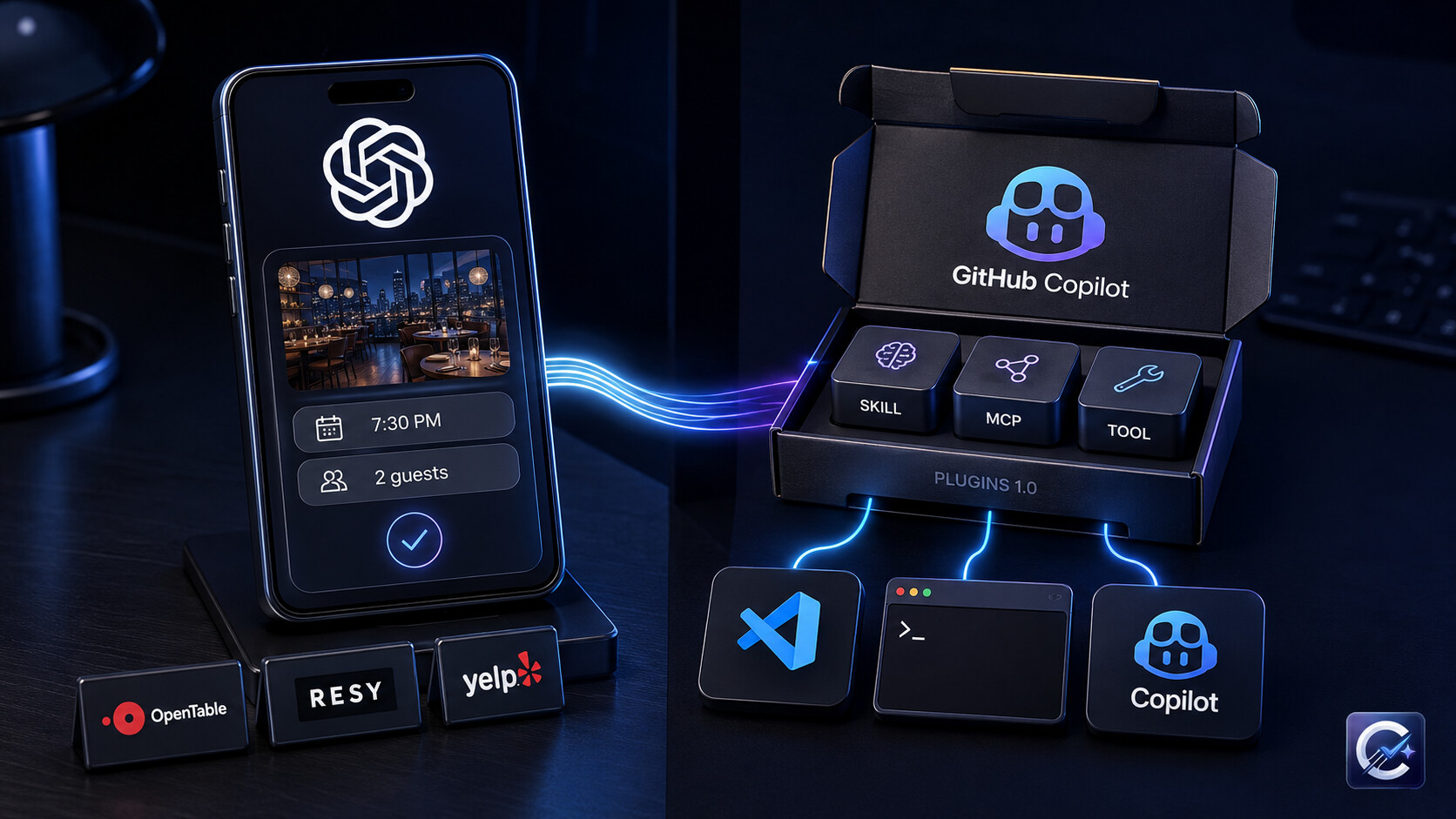
Verified change brief
Two releases this week moved AI products closer to completing real actions rather than stopping at an answer.
ChatGPT can now surface restaurant reservation times and move users into a booking flow. GitHub has released Agent Plugins 1.0 across its principal Copilot clients, creating a shared package for reusable agent capabilities.
Neither development requires an immediate stack change. Both deserve attention because they reduce the distance between an AI recommendation and the action that follows it.
ChatGPT can now help find and book restaurant reservations
OpenAI added restaurant reservation search to ChatGPT on August 10, 2026.
Users can ask for a restaurant by location, date, party size, budget, cuisine or atmosphere. ChatGPT can then show available reservation times inside the response and provide a route to complete the booking through a supported reservation service.
The feature is available across ChatGPT Free, Go, Plus and Pro on mobile, web and desktop. OpenTable coverage is global. Resy is available in the United States, while Yelp supports the United States and Canada. Restaurant reservation search is not included in ChatGPT Work.
Who is affected
The immediate benefit is for individual ChatGPT users who already use the product for local recommendations or travel planning. It shortens a familiar sequence: ask for suggestions, compare options, open another service, repeat the search and then book.
Restaurants and reservation platforms may also see ChatGPT become another discovery layer between a customer and the booking page. The final transaction still happens through the participating reservation service rather than inside a universal OpenAI booking system.
What it means in practice
The change makes ChatGPT more useful, but it does not make reservation details self-verifying.
Before confirming, check the restaurant, location, date, time, party size, booking service and cancellation terms. Those details matter more than the quality of the conversation that produced them.
Availability will also vary by market and participating service. A global ChatGPT rollout does not mean every restaurant or reservation platform is represented everywhere.
Choosely's recommendation
Use the feature when it removes repetitive searching, but treat the linked booking page as the final record. Review the details there before committing.
For teams using ChatGPT Work, do not plan a workflow around restaurant reservations because the feature is not currently included.
GitHub releases Agent Plugins 1.0
GitHub released Agent Plugins 1.0 on August 12, 2026 across Visual Studio Code, Copilot CLI and the Copilot app.
An agent plugin is an installable package of reusable agent capabilities. A package can include agent skills and Model Context Protocol servers, allowing instructions and tool connections to travel together across clients that support the format.
The proposition is straightforward: package a capability once, then reuse it in compatible agent environments instead of rebuilding the same setup for each surface.
Who is affected
The release matters first to developers and teams already using GitHub Copilot across the editor, command line and Copilot app. It also matters to organisations building internal agent capabilities that need a more repeatable installation and update path.
It does not make plugins portable across every AI agent product. Current support is explicit inside GitHub's named clients. Other products must support the shared format before the same package can travel reliably outside that environment.
What it means in practice
Plugins can reduce duplicate setup work, but they also combine several trust decisions into one installation.
A package may contain instructions that shape agent behaviour, MCP servers that connect to external systems, and tools with permission to read or change information. That is operational capability, not decorative configuration.
The convenience therefore increases the importance of reviewing what is inside the package, where it came from and how it will be updated.
Choosely's recommendation
Treat an agent plugin like an executable capability bundle.
Before installing one in a production environment, review:
- 1The publisher and source repository.
- 2The skills and instructions included in the package.
- 3Every MCP server or external connection it introduces.
- 4The permissions available to those tools.
- 5The update, removal and recovery path.
Start with one bounded internal use case. Confirm that the plugin behaves consistently in each client you intend to support before describing it as portable.
The practical move this week
Inspect one place where an AI product can now move from advice to action.
For a booking, verify the final transaction details. For an agent plugin, verify the package contents and permissions. In both cases, make sure a person can inspect, correct or reverse the result before the workflow becomes routine.
The useful question is no longer only whether the AI produced a good answer. It is whether the next action remains visible and controllable.
What remains unclear
OpenAI has not published a complete restaurant-by-restaurant coverage list. Actual availability depends on location, participating venues and reservation-platform inventory.
Agent Plugins 1.0 has confirmed support across GitHub's three named Copilot surfaces. Its broader value will depend on adoption by other compatible clients and on how consistently packages, permissions and updates behave between them.
Also from AI Radar this week
Verified sources
- OpenAI: ChatGPT release notes (restaurant reservations added August 10, 2026)
- GitHub: Agent Plugins 1.0 in VS Code, Copilot CLI and the Copilot app (August 12, 2026)
Sources were checked on August 14, 2026. Choosely has not independently tested restaurant-reservation coverage or cross-client Agent Plugin portability.
The Change Brief
Get the week’s AI changes in one clear read
Pricing moves, tool launches, free-tier changes and practical stack updates, filtered for people who actually use these tools.
Stay ahead of AI without following it all day. We’ll send you what matters each week.
Continue reading
Related reads
Product Update
Claude's Invisible Watermark Is Real. The Panic Is Ahead of the Facts
Anthropic's invisible Claude watermarks are real, but claims that every current response and document is already secretly tracked go beyond the evidence.
AI Tool Recommendations
Seedance 2.5 vs Kling 3.0: Which AI Video Model Should You Actually Use?
Seedance 2.5 leads on longer multimodal sequences and localized editing. Kling 3.0 remains the stronger documented fit for native 4K, structured shots, and controlled dialogue.