 CHOOSELY
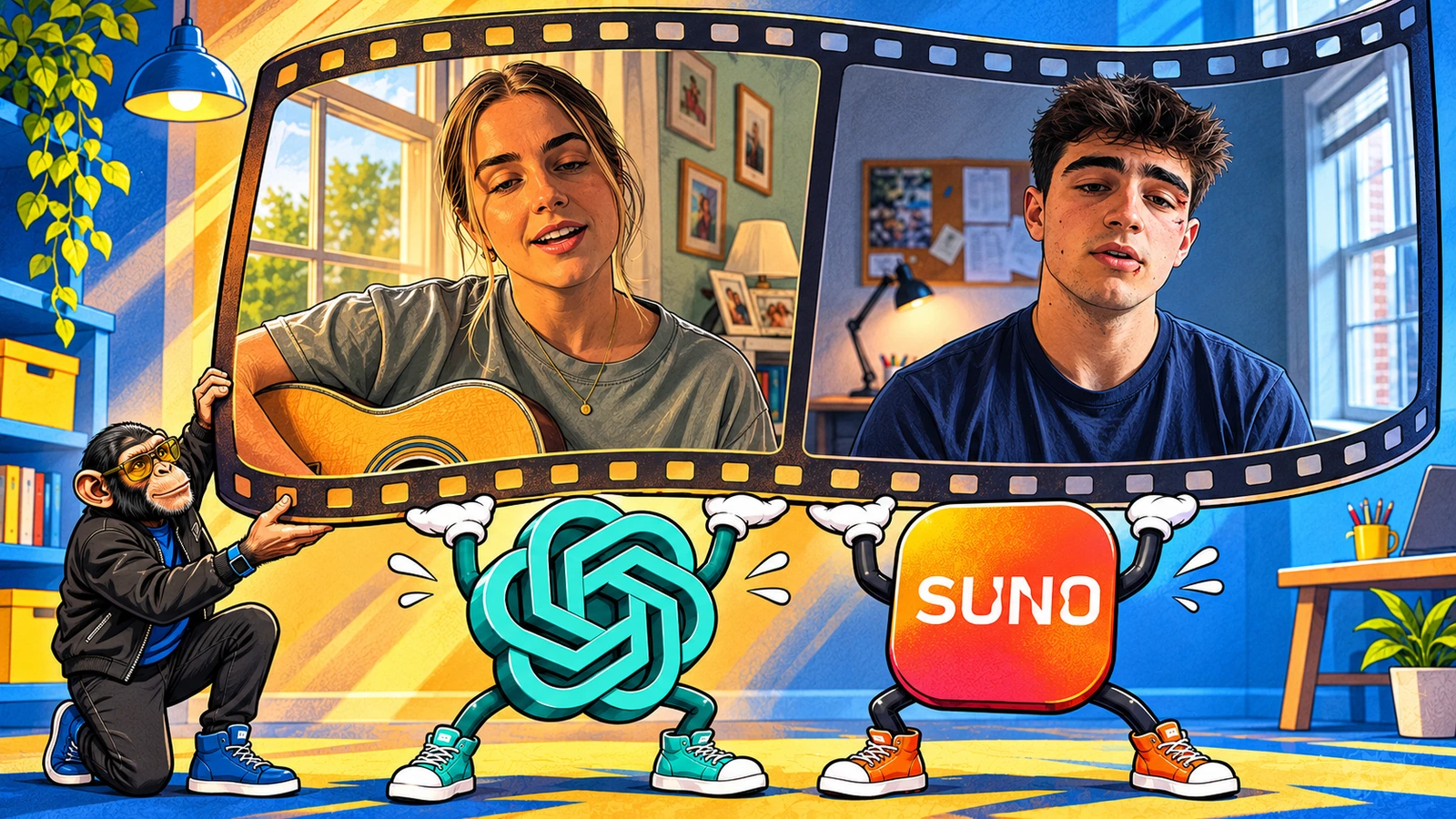
A woman gets a job offer and almost calls her ex. A man in another room answers with the part of their breakup she has left out. Near the end, we return to her, and the same line means something different.
That is the finished shape of “I Nearly Called (Two Sides),” our original, roughly 40-second music Reel. We used GPT-6.1 Sol Ultra in ChatGPT for the research, lyrics and planning. Suno generated the music and singing, and Suno Visuals generated the performers and footage. Both characters are fictional adults.
We finished a usable private cut. Getting there involved choosing a story, rejecting takes, correcting a reference image and assembling short shots around continuous audio. If you want to make something similar, the sensible place to start is a song excerpt you care about and a short singing-video proof before committing to more footage.
An original AI-generated song and video made with ChatGPT, Suno and Suno Visuals, directed and edited by Choosely. The two performers are fictional. We assessed the production workflow and collected no audience-performance results for this project.
Video transcript
I got the job today. I thanked them twice. Your name was on my screen. I nearly called. You’d ask me how it went. I’d tell you every word. I had a good day. I wanted one with you. You cheated with my best mate. I nearly called him first To tell him what you’d done, Like he hadn’t been there. His name was on my screen. I put the phone down. He was the one I’d call When it hurt this much.
The lyric needed a reason to call
Our first problem was more basic than video quality. The sound was getting close to what we wanted, but the early lyrics did not make us feel much.
We had started by asking whether studying successful music could help ChatGPT write a better creative brief. A six-month chart screen gave us examples to investigate. It did not supply a reliable recipe for an original song, let alone a viral one.
The useful change was a specific occasion: getting a job and still wanting to tell the person who used to hear everything first.
I had a good day.
I wanted one with you.
Those original lines gave “I Nearly Called” its tension. You can know a relationship should stay over and still miss the person you would have called with good news.
We then proposed a second perspective. Let her tell a sympathetic, truthful part of the story first. Then let him explain why he stopped answering: she cheated with his best friend.
That could easily become a cheap reversal. We kept his response focused on losing two people. The friend is also the person he would normally call when something hurts. The title now belongs to both of them.
ChatGPT wrote the two short sections and a brief for a shared acoustic backing, with the woman singing first and the man entering alone afterward. The music came from paid Suno v6 on Pro. An earlier solo recording served as a benchmark; it is not the audio in the finished Reel.
The ending we stopped trying to repair
The final audio uses an excerpt of the original fourth duet take. Around 19 seconds into the Reel, the man's answer makes the betrayal clear. Later, the last vocal sounded more like the woman's voice to us.
We initially treated that as something to fix. Joining pieces of the audio left a cut we could hear. Generating new versions changed the feel of the performance. An edit aimed specifically at the ending did not produce the repair we wanted.
The useful decision came when we reconsidered what the apparent voice change could mean.
At 33.6 seconds, the video returns to the woman for:
He was the one I'd call.
From his side, “he” is the best friend he can no longer trust. From her side, it is the former partner she still wants to share her life with. We kept the original duet audio and changed who we showed.
That is our reading of the performance, not a verified speaker label supplied by Suno. The return does not excuse her betrayal. It gives her loss a place in the ending without taking his away.
This was the most useful creative intervention in the project. More attempts at repairing the voice had been pulling us away from the take we liked. A human decision about the story made the existing performance usable.
A believable room did not guarantee believable singing
We also tried Higgsfield during an earlier, solo version of the project. It is important to separate the two routes we used there.
The first was a 21-second Seedance 2.5 generation using an audio reference. Its silent output looked slightly more authentic to us than the Suno preview. But putting the original song underneath it did not make the mouth movements match. We rejected the lip sync.
We then tried a tool designed specifically to match mouths to audio: Sync Lipsync 3, through Higgsfield. For this six-second test, we supplied a version with the instruments removed so the tool could follow the singing more clearly, then put the full song audio back. We found it better, but still off, and preferred the Suno result.
Those are judgments about these attempts. The previews did not all use identical source windows and settings, so this was a practical workflow comparison rather than a matched ranking of the providers. Higgsfield documents dedicated processing of existing footage separately from generating video with audio. Sync documents singing support; our result does not establish a general limit on what either system can do.
Suno Visuals gave us the more useful route for this project. It lets you choose audio from a Suno song or an upload, select an excerpt and enable singing lip sync. Its video guide lists Fast at 480p and Standard at 720p, with individual clips from five to 15 seconds and a vertical 9:16 option.
The first Suno proof was a 12-second Fast-mode solo clip. It returned two alternatives and also introduced nonsense lettering on the woman's shirt.
For the final work, we used ChatGPT image generation to retouch only the shirt in the approved reference. We uploaded that clean reference with approval, then used matching continuations and the source audio. A plain-shirt instruction was useful; a reference that actually showed a plain shirt was the stronger starting point in our workflow.
Five generated shots became three story beats: her account, his answer and the return to her. We also chose to keep the marks on the male character's face. We did not treat every visible imperfection as a reason to start again.
In the opening bedroom shot, the guitar and finger detail looked convincing, but the visible strumming was out of time with the track. A pre-release viewer independently spotted the mismatch. We asked Suno Visuals to edit the shot so the visible strums matched the guitar in the track. In our follow-up test, the strumming still didn’t line up. We reframed the shot in CapCut to crop out the hands, making it less noticeable. That was a framing workaround; it did not fix the generated strumming timing. This was a separate issue from lip sync.
Our AI assistant first joined the chosen shots in a separate video-editing step, keeping the original song excerpt continuous. That master was 39.95 seconds long in vertical 720p. Our reframed version is the cut selected for this article. Suno also documents a Visuals Editor for arranging clips, but the final assembly in this test happened outside it.
What the attempts cost
Suno's Song and Visual credit balances are separate. Image and video generations, including edits that generate new visual content, use Visual credits. Suno says video cost depends on duration and quality, so the figures below describe our account and requests, not a universal price list. These figures cover the original production; credit use for the later strumming follow-up was not reported.
| Work | Recorded use |
|---|---|
| Earlier paid solo music work | 60 paid Song credits |
| Vocal separation for the dedicated lip-sync test | 10 Song credits |
| Duet development and attempted audio fixes | 90 paid Song credits, measured from the account totals |
| Early 12-second Suno Visuals solo proof | 180 Visual credits, for two alternatives |
| Final Reel's five source generations | 1,260 Visual credits, with two alternatives per request |
| Downloads during the duet work | Two: the original fourth take and a rejected ending fragment |
The duet figure comes from account snapshots: paid Song usage rose from 70 to 160 credits while the duet work was being done. We have not assigned that 90-credit increase to individual jobs without the corresponding debit evidence.
The final visual requests covered seven, eight, nine, 11 and seven seconds: 42 requested seconds in all. That total includes a seven-second reveal proof we reused. It is different from the length of the finished edit, and it excludes the earlier 12-second solo proof.
Together, the early proof and original Reel production used 1,440 Visual credits, drawn from trial credits and a purchased pack. Joining the shots and removing the opening title did not incur another Visuals generation charge.
We paid US$14.99 for a 2,500-Visual-credit pack, used alongside the account's trial allowance. Subscription costs, human time and the ChatGPT image edit have not been allocated into a full cash total. Check the current signed-in quote for your account before buying.
The two Higgsfield attempts had quoted costs of 63 and 21.6 Higgsfield credits. Those are a separate provider's units, not Suno Visual credits, and should not be added to the Suno balance.
What this test can tell us
The research behind the project covered 27 weekly US Billboard Hot 100 issues within May 22 to November 21, 2026. We selected six songs reaching the top 10 for the first time and two tentative lower-chart comparisons. We could reliably examine the published lyrics for seven of those eight songs. Returning choruses appeared in both groups, which gives us no basis for calling repetition a predictor of success. The publisher's first and last issues are available on Billboard's Canadian edition.
We did not measure where hooks began in the commercial recordings or obtain comparable data showing how long people watched their short videos. That research could not tell us what would make our Reel spread.
A separate private exercise compared 12 Suno v6-mini outputs using identical lyrics and one listener's blind scores. It used 60 Free Song credits. That small prompt comparison does not validate this song, the video or the chart-derived ideas.
ChatGPT handled research, lyrics and planning for the finished project. A separate AI assistant handled provider operations and editing. We supplied direction, judged the outputs and made the final story decisions, staying involved from the first brief to the final cut.
At the close of this private test, the Reel had not been posted to Instagram, TikTok or YouTube. We collected no public view, completion or retention data for this project.
Choosely’s verdict
ChatGPT and Suno were useful partners for making a short original music video. The part worth repeating is the order of decisions: find a lyric with a believable human occasion, choose the audio you want to keep, then test a short singing shot before building more footage.
For this project, Suno Visuals was the route we preferred. Expect to select between alternatives, check mouths against the actual vocal and carry a clean character reference through the sequence. A plausible first clip is only the beginning of that work.
The most important choice was which performance to keep. We retained the original duet audio, returned to her and let the same line mean something else.
The Change Brief
Get the week’s AI changes in one clear read
Pricing moves, tool launches, free-tier changes and practical stack updates, filtered for people who actually use these tools.
Stay ahead of AI without following it all day. We’ll send you what matters each week.
Continue reading
Related reads
Product Update
Suno v6 Replaced Every Older Model. What Actually Changed?
Suno v6 is a platform reset with three new models, conversational editing, multimodal inputs, retired legacy models and stricter download rules.
AI Strategy
Can You Put Suno Songs on Spotify and Make Money?
Check your Suno song’s rights, distributor eligibility, release costs and payout conditions before putting it on Spotify.
AI Creator Workflows
Inside Promptgenix's AI Music Videos: The Stack Behind the Alien-Blues Visuals
Promptgenix combines generative music, a conventional DAW, AI image creation, image-to-video tools, and patient manual editing in a one-person production workflow.