 CHOOSELY.AI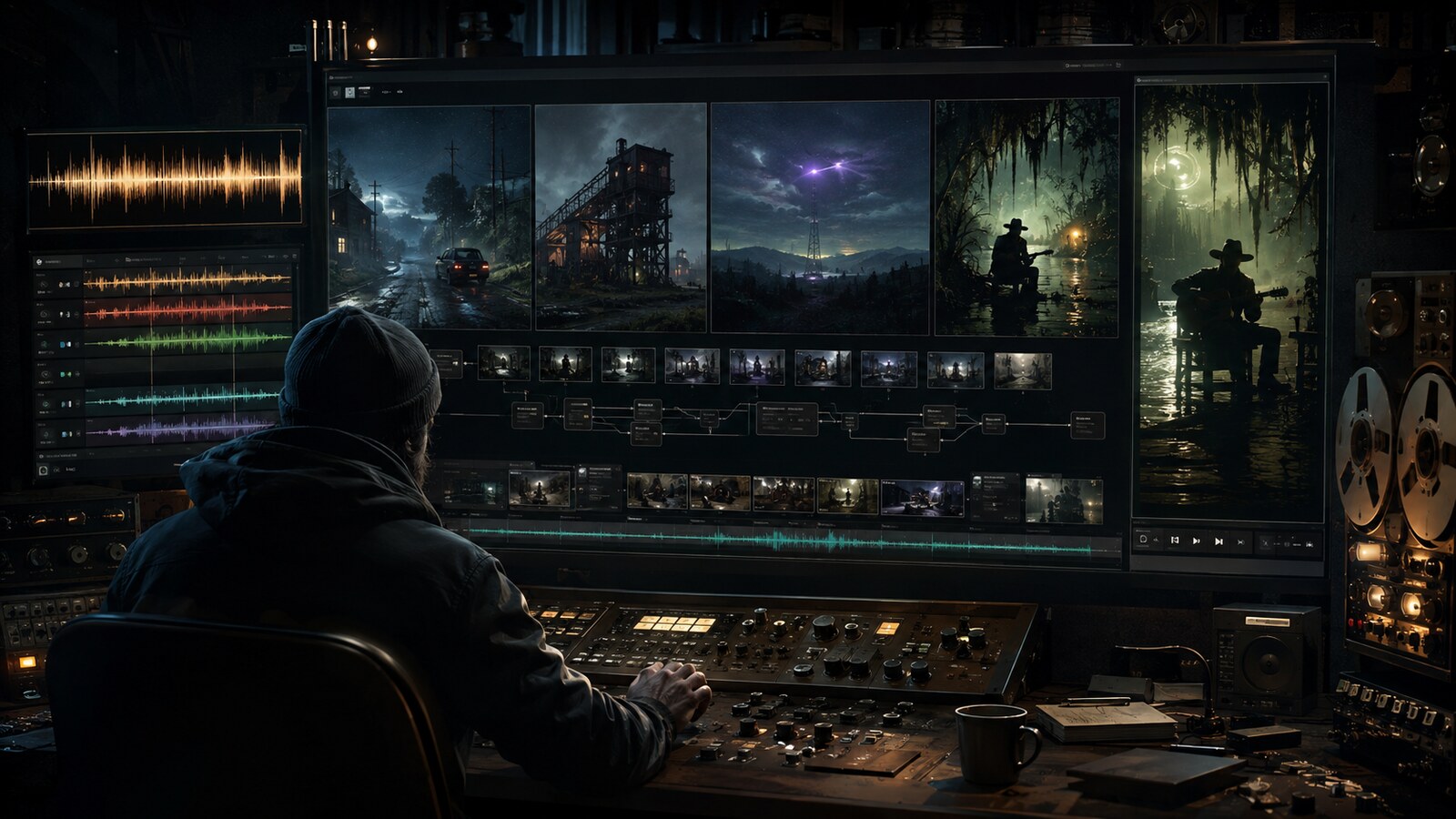
Promptgenix's strange mix of alien blues, Appalachian folklore, and cinematic AI visuals has built a serious audience across TikTok and music streaming. The obvious question is how one person is making it. The answer involves several AI tools, a traditional audio workstation, and far more manual direction than the finished clips suggest.
Promptgenix says the music is built with Suno Studio and Ableton Live. The source images are created in Midjourney, with Midjourney and occasionally Grok used to animate them. Recent posts also promote Runway with a dedicated Promptgenix discount code, although the creator has not publicly explained whether Runway has replaced part of the earlier workflow or simply joined it.
There is no single magic video generator hiding behind the account. Promptgenix says a one-minute video can take four to six hours, with each image prompted separately, animated, and edited to the music. The software matters. The production discipline matters more.
This analysis is based on Promptgenix's direct public statements, visible platform evidence, and official product documentation. Choosely has not inspected the creator's project files or independently reconstructed the workflow. The article therefore separates what Promptgenix has stated from what the wider evidence merely suggests.
The Promptgenix AI stack, based on current evidence
| Production job | Tool or method | Evidence strength |
|---|---|---|
| Lyrics | Written by the Promptgenix creator | Direct creator statement |
| Music generation and arrangement | Suno Studio | Direct creator statement |
| Audio stems and final production | Ableton Live | Direct creator statement |
| Vocals | AI-generated, with the voice directed for each style | Direct creator statement |
| Source images | Midjourney | Direct creator statement |
| Image animation | Midjourney and occasional Grok use | Direct creator statement |
| Current Runway role | Promptgenix repeatedly promotes Runway with a dedicated discount code | Confirmed promotion, production role unclear |
| Final video assembly | Manual scene-by-scene editing | Process confirmed, editing software unknown |
The most important row is the last one. Promptgenix is not uploading a song and accepting whatever visualizer appears. The creator describes prompting each image, animating each shot, and then assembling the sequence around the music.
That distinction explains why the clips feel more coherent than the usual AI-video lottery. A model can generate an impressive swamp creature. It does not automatically know that the next shot should deepen the same world, preserve the same emotional temperature, and land on the right musical phrase.
Which parts of the stack are actually essential?
Promptgenix's named tools are useful evidence, but they should not be mistaken for the only viable combination. The production logic matters more than matching every subscription.
| Production layer | Promptgenix-reported choice | What a reader actually needs |
|---|---|---|
| Music generation | Suno Studio | A music model that can produce material suitable for further editing and the intended release rights |
| Audio production | Ableton Live | A DAW that can import and edit separate audio stems |
| Source images | Midjourney | An image generator capable of maintaining a deliberate visual language across many separately created shots |
| Shot animation | Midjourney, occasional Grok use, and a possible current Runway role | Image-to-video control over movement, camera behavior, and individual shots |
| Final assembly | Editing software not publicly identified | A timeline editor that can cut short generated clips accurately to music |
Ableton can therefore be substituted more easily than the creator's visual judgment. The same is true of the final editing application. Replacing Midjourney or the animation model is possible, but it changes the generation behavior the creator must direct and correct.
Who is behind Promptgenix?
Promptgenix appears to be a one-person project run by a creator from New York. The creator has publicly described a background in graphic design and photography, roughly ten years of classical piano experience, and a long-running interest in Appalachian folklore, cryptids, aliens, and horror.
The project began with video rather than music. Promptgenix says the original problem was finding suitable music for AI visuals without dealing with licensing friction. The creator started making original tracks for the videos, viewers asked where they could hear the full songs, and the music was eventually distributed to streaming platforms.
That origin story is useful because it explains the unusual strength of the visual identity. The music was not released first and decorated later with unrelated AI clips. Promptgenix has been building a shared fictional universe in which the songs and images are designed to belong together.
The creator remains publicly pseudonymous. Choosely found no reliable reason to push beyond the background details Promptgenix has chosen to disclose.
How the music is made
Promptgenix says the lyrics are written by the creator, then developed into songs through Suno Studio. The prompts reportedly specify genre, tempo, instruments, rhythm, vocal style, mood, structure, and smaller production choices such as drum feel, bass movement, and vocal delivery.
That first generation is not treated as the finished record. Promptgenix describes creating multiple versions, rewriting, and continuing until the track reaches the intended feeling. The vocals are AI-generated, and different voices can be directed for different styles.
Suno Studio provides the generative production layer. Ableton Live provides a more conventional editing and mixing environment. Promptgenix says stems are extracted from Suno Studio and brought into Ableton, where they can be handled like material inside a digital audio workstation.
That workflow is technically supported by Suno's own documentation. Suno Studio can export individual clips and multitrack stems for use in an external DAW. The creator is therefore able to move beyond a flattened full-song file and work with separate musical elements.
This still leaves an important limit. Choosely has not seen the sessions and cannot measure how much arrangement, processing, replacement, or mixing occurs inside Ableton. We can identify the workflow without pretending to know every fader position.
How the visuals are made
The publicly confirmed visual process is straightforward to describe and considerably slower to execute:
- 1Develop a scene that belongs inside the Promptgenix universe.
- 2Generate the source image in Midjourney.
- 3Animate the image using Midjourney or, on some projects, Grok.
- 4Repeat the process for every shot.
- 5Edit the shots together against the finished music.
Promptgenix says a minute-long video can take four to six hours. Each image is prompted individually, then animated and edited into the final sequence. That is closer to building a compressed music video from generated shots than asking one model for a complete film.
Midjourney's current product supports this process directly. A still image can be converted into a five-second video, with motion level, loops, end frames, and manual motion prompts available. Runway also supports image-to-video generation, with its current guidance telling creators to focus the prompt on subject, environment, and camera movement.
The tools can create motion. Promptgenix supplies the art direction that keeps the motion inside the same grimy, cosmic, Appalachian world. That is the part most copycat workflows will underestimate.
Is Promptgenix using Runway?
Runway is the largest unresolved part of the current stack.
Promptgenix has repeatedly published a dedicated PROMPTGENIX25 code offering 25 percent off new Runway subscriptions. Runway operates an affiliate program and a separate Creative Partners Program for selected creators, so a public promotion arrangement is plausible.
The code confirms a promotional relationship of some kind. It does not establish which Promptgenix videos used Runway, which Runway model was selected, or whether the tool has replaced Midjourney or Grok for animation.
Recent Promptgenix captions make Runway highly relevant to the article. Accuracy requires keeping the claim narrow until the creator or Runway confirms the production details.
Our current wording is simple: Promptgenix publicly promotes Runway, and Runway may now form part of the visual workflow. Its exact role remains unconfirmed.
Promptgenix is no longer a small AI experiment
Promptgenix had approximately 211,000 TikTok followers and 1.61 million accumulated likes when checked on August 18, 2026. A third-party TikTok tracker estimated an average of roughly 56,900 views, 3,480 likes, 168 comments, and 456 shares per video across the account.
The distribution is uneven, as TikTok distribution usually is. Several Promptgenix videos have crossed 1.7 million views, while newer posts range from a few thousand views to more than 600,000. That spread is healthier evidence than one isolated viral clip. The format has produced repeated breakouts.
The audience also follows the music away from TikTok. Spotify showed approximately 169,000 monthly listeners when checked, with the leading tracks carrying hundreds of thousands of plays. The YouTube channel had more than 42,000 subscribers, while Shazam recorded tens of thousands of identifications for the most popular songs.
The project has therefore crossed an important line. People are not merely watching attractive clips in a feed. They are searching for the music, adding it to their listening, and asking how the work is made.
That last behavior is the reason this article exists.
Why this matters beyond one TikTok account
Promptgenix is part of a broader change in what a solo creator can produce. Generative music, image creation, image-to-video models, and conventional editing software can now be joined into a production line that previously required several specialists.
That does not make the work automatic. It changes the creator's job. More time moves from performing every instrument or filming every shot toward directing models, rejecting weak outputs, preserving continuity, and assembling the accepted material into something recognizably its own.
Promptgenix also demonstrates why the strongest AI-native projects do not stop at an impressive feed clip. The videos create discovery, but the full songs give the audience somewhere to go next. TikTok attention can become Spotify listening, YouTube subscriptions, and Shazam searches. The visual world is doing distribution work for the music, while the music gives the visual project more depth than a collection of disconnected AI demonstrations.
For creators trying to reproduce the model, that is the more useful lesson. A repeatable world, a release destination, and patient editing are more defensible than temporary access to any single generator.
Is Promptgenix an AI band?
Promptgenix is better understood as an AI-assisted music and visual project run by one human creative director. The instruments and vocals are generated with AI. The creator says the lyrics, musical direction, iteration, visual concepts, selections, and editing decisions are human-led.
Some listeners will still call it an AI band. Fair enough. The label matters less than being accurate about the production.
Promptgenix says the tracks are original compositions made with licensed AI tools, without direct sampling or cloning the voices of real artists. Choosely has not independently audited the generation history, so that remains an attributed creator statement rather than a verified forensic finding.
The more useful question is whether meaningful creative decisions remain after generation. In this case, the public process shows plenty of them. A model produces options. Promptgenix keeps choosing which sound, shot, movement, character, and strange piece of roadside folklore belongs in the world.
Can you recreate Promptgenix's videos with the same tools?
You can reproduce the broad workflow:
- Use Suno Studio to generate and arrange the track.
- Export stems into Ableton or another DAW.
- Create a visual world and source images in Midjourney.
- Animate those images with Midjourney, Grok, Runway, or another image-to-video model.
- Edit the short shots manually to the music.
You should not expect the same result simply because the subscription list matches.
The recognizability comes from the repeated choices: dirty industrial textures, haunted rural America, alien technology, blues and trapgrass genre mixing, restrained movement, and a consistent narrative atmosphere. Promptgenix has built a visual and musical grammar. The AI tools are executing it one generation at a time.
The subscription stack can be copied in an afternoon. The taste layer will take longer.
Choosely verdict
Promptgenix currently uses one of the clearest hybrid AI-creator workflows we have seen in short-form music content. Suno Studio generates and develops the music. Ableton Live provides production control. Midjourney builds the visual world. Midjourney and Grok animate at least some of the images. Runway is now being promoted heavily enough to matter, although its exact production role still needs confirmation.
The result is not proof that AI can replace a band, filmmaker, or editor. It is proof that one person with musical knowledge, visual training, strong taste, and enough patience can direct a surprisingly large production stack.
Anyone searching for the one tool behind those visuals will leave slightly disappointed. There is no shortcut hiding in the captions. There is a creator spending four to six hours turning generated fragments into one minute that feels as though it came from the same universe.
That is considerably more interesting.
Want the AI-tool changes and creator workflows worth paying attention to? Subscribe to [The Change Brief](https://choosely.ai/#change-brief).
Frequently asked questions
What AI does Promptgenix use?
Promptgenix says the project uses Suno Studio for music generation, Ableton Live for working with audio stems, Midjourney for visual creation, and Midjourney plus occasional Grok use for animation. The account also promotes Runway with a dedicated discount code, but Runway's exact production role has not been confirmed.
Does Promptgenix use Suno?
Yes. The creator has directly stated that Promptgenix uses Suno Studio to build the music, then exports stems for further work in Ableton Live.
Does Promptgenix write its own lyrics?
The Promptgenix creator says the lyrics are personally written and then combined with detailed musical instructions inside Suno. Choosely has not independently inspected the lyric or project history.
How long does a Promptgenix video take to make?
Promptgenix says a minute-long video usually takes four to six hours. Each image is separately prompted, animated, and edited into the final sequence.
Is Promptgenix an AI band?
Promptgenix is a one-person AI-assisted music and visual project. Its instruments and vocals are AI-generated, while the creator says the lyrics, direction, iteration, visual concepts, and editing decisions are human-led.
Does Promptgenix use Runway?
Promptgenix repeatedly promotes Runway using a dedicated discount code. This confirms a promotional relationship, but it does not prove which videos or shots were made with Runway. The current production role remains unconfirmed.
The Change Brief
Get the week’s AI changes in one clear read
Pricing moves, tool launches, free-tier changes and practical stack updates, filtered for people who actually use these tools.
Stay ahead of AI without following it all day. We’ll send you what matters each week.
Continue reading
Related reads
AI Strategy
How Chloe vs History Went Viral with Seedance 2.0: Inside the AI Stack Behind 2026's Breakout History Channel
Chloe vs History looks like a viral AI video story. It is actually a workflow story — and the tool stack powering it is a textbook case of matching the right AI tool to the right job at...
AI Tool Recommendations
Best AI Video Generator in 2026: Seedance vs Veo vs Kling vs Runway
Seedance, Veo, Kling and Runway can all create impressive AI video, but they solve different production problems. Here is how to choose the right model for your workflow.