 CHOOSELY.AI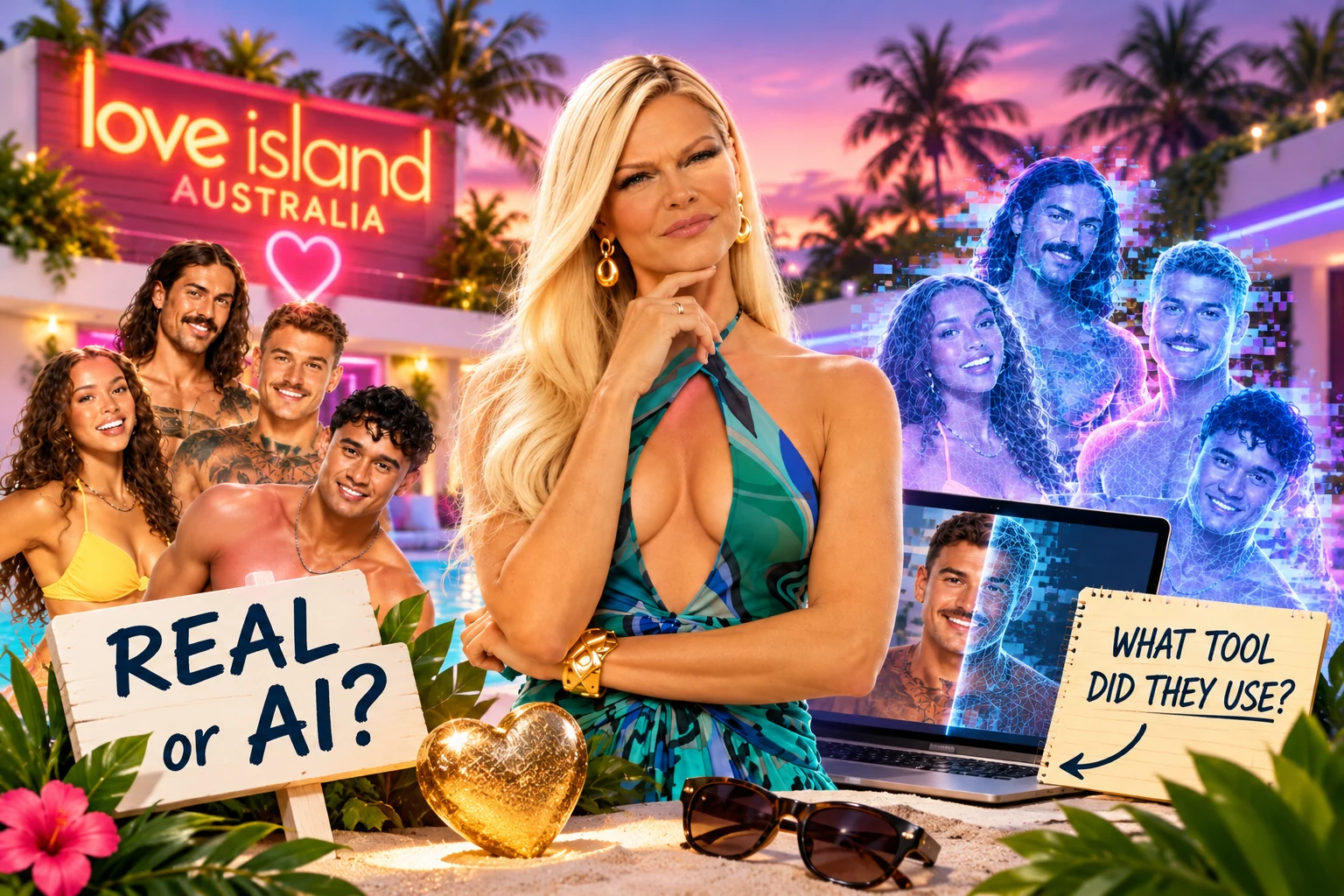
Hero image: AI-generated Choosely editorial illustration, not a frame from Nine’s promo. The digital doubles are a visual metaphor, not evidence about any participant.
The exact AI tool behind Love Island Australia’s 2026 promo has not been identified in the public sources reviewed for this article as of October 11.
That is the answer to the generator question. The more useful investigation is what the available evidence can tell us about the production: which elements are reported as synthetic, what Madix says she knew, and what Nine has disclosed about AI in its creative operations.
Those are separate questions. An Instagram label cannot answer all three.
What happened with the Love Island Australia AI promo?
The campaign promotes the Australian series moving into the Love Island USA villa in Fiji.
E! News reports that the Instagram promo was posted on October 4 and carried an AI-content label. It describes Madix handing over the villa keys before the sequence moves to Australian host Sophie Monk.
The joke is that the property needs an Australian makeover.
According to WHO’s description of the promo, Monk calls for “Ausification.” The subsequent imagery includes shirtless men carrying a barbecue and an esky, the Australian term for a cooler, a portrait of Vegemite, and swimsuit characters labeled Tim and Tam.
WHO identifies those scenes in its account of the AI-labeled campaign. That reporting does not establish which individual objects were generated, whether an entire shot was synthetic, or how the footage was assembled.
The campaign details that Nine has confirmed are more straightforward. Its October 9 announcement sets the season-eight premiere for October 26 and identifies ITV Studios Australia as the series producer.
That is a series credit. It is not a credit for the advertisement’s AI work.
What Ariana Madix actually said
The important distinction is between filming an appearance and knowing how that appearance would be presented.
In a comment reproduced by E! News, Madix said:
“They didn’t tell me AT ALL that the clip I shot would be used with AI.”
E! attributes the comment to a screenshot shared by fan accounts. It also reports her opposition to that use.
PEDESTRIAN.TV reports that Madix subsequently clarified that she filmed her appearance. Her complaint, as reported, concerns the finished campaign rather than a claim that she never participated in the shoot.
That does not establish that her face or voice was generated. Nor does acknowledging a shoot establish approval of every possible treatment of the footage afterward.
The public comments do not provide the production brief, approval correspondence or contractual terms. They should not be stretched into a finding about any of them.
E! said it requested comment from ITV Studios Australia and had not received a response when it published. PEDESTRIAN.TV said it contacted Nine and Madix. No substantive campaign-specific response was found in the sources reviewed by October 11.
What the AI label tells viewers
An AI label is useful context. It is not a production report.
Meta’s published explanation says labeling can rely on industry-standard indicators or a person disclosing that they are uploading AI-generated content.
Meta has also acknowledged that some earlier labels appeared on material containing relatively minor AI modifications, including retouching. It subsequently described different treatment for detected generation and AI-assisted editing.
For this campaign, the specific labeling trigger has not been independently verified in the sources reviewed.
The reported label therefore cannot identify the generator, tell viewers which person or prop is synthetic, or establish what either presenter was told.
There is a simple distinction worth keeping: labeling tells the audience something about how a platform has classified an upload. A production credit identifies who did the work. A briefing records what participants were told to expect.
Nine’s AI direction predates the backlash
There is direct corporate evidence for the broader story.
On page 13 of its February 24 H1 FY26 presentation, Nine listed the following under restructuring its Streaming and Broadcast business:
“Utilising AI to consolidate our creative and promos teams”
That is an explicit connection made by Nine, not an inference drawn from the Love Island visuals.
Its August results announcement, reproduced by Market Index, subsequently described consolidating creative and promotions teams and unifying technology stacks as part of bringing Streaming and Broadcast closer together.
Neither passage identifies this advertisement’s producer, model or budget. Neither establishes that a particular organizational change caused the disputed creative treatment.
The documents provide context for the campaign. They do not supply its missing credits.
The Block provides a separate, documented example
Nine’s television output already includes AI work discussed by a named production executive.
In an August 6 interview with WHO, The Block’s post-production executive producer David Barbour described using AI for playful animations, talking animals and original music.
WHO’s examples included a horse sequence associated with contestant Tayla and a talking monkey-head treatment associated with Rick. Barbour’s explanation was that these tools expanded the production team’s storytelling options.
In a separate interview about the music, he said AI-generated music was incorporated alongside the traditional music library. That matters: it is not evidence that the show replaced all of its existing music with generated tracks.
These interviews establish another use of AI in Nine programming. They do not establish shared software or personnel with the Love Island campaign.
The Block is a precedent for adoption, not a shortcut to identifying the promo’s generator.
What AI tool did Love Island Australia use?
No verified campaign-specific disclosure naming a tool, model, AI artist or post-production supplier was located in the material reviewed.
Naming a generator from the visual style would be guesswork. A recognizable artifact can suggest something to investigate, but it cannot establish where a clip came from.
It would also be premature to assume there was one generator responsible for the entire advertisement.
A useful production disclosure would identify what each tool did: generating a new shot, changing existing footage, creating an image that was later animated, or supplying a component for conventional post-production.
Even a future platform credit may leave questions open. Knowing which application was used does not necessarily identify the underlying model or which parts of the final edit came from it.
Three production jobs that can create similar results
The following describes possible production methods, not a reconstruction of Nine’s workflow.
Generate new shots. A team can create a separate synthetic clip from a written description or reference image, then place it between filmed scenes. Adobe’s text-to-video documentation describes one implementation of that production job.
Modify filmed material. AI editing can change elements within an existing clip. For example, Runway’s Aleph documentation describes editing footage, including adding or altering objects and visual effects. This is a capability example, not evidence of Runway’s involvement.
Combine separately created elements. A possible finishing workflow would bring filmed material and generated assets into the same edit, matching their timing, scale, lighting and sound.
Those routes could be used separately or together. None has been confirmed as this campaign’s actual method.
For readers choosing software for their own production, Choosely’s AI video generator guide addresses that different question. This advertisement does not provide a defensible recommendation for one model over another.
What creators and campaign buyers should take from it
The practical lesson does not depend on deciding whether the barbecue gag was funny.
For an AI-assisted campaign, the brief should describe the finished treatment. “Film a presenter introduction” leaves important creative questions unanswered if the planned result places that presenter alongside generated people or environments.
A useful approval pack would separate the original filmed material from proposed synthetic additions and show how they will appear together. Where a person’s appearance or voice will be modified, describe that separately from changes to the surrounding scene.
Keep a simple production record as well: the source asset, the tool used, the operation performed and the approved output. That makes later revisions and questions about the finished campaign easier to resolve.
These are recommended working practices. They are not findings about what Nine or ITV did behind the scenes.
Quality review is another distinct job. For a similar campaign, useful checks would include continuity between shots, contact between people and objects, matching light and perspective, readable graphics and consistent sound.
Those are things to inspect. They are not a diagnosis of errors in this promo or a way to identify its model.
Finally, measure the campaign against its purpose. A comment thread full of arguments about production technology is not, by itself, evidence that an advertisement succeeded or failed at attracting viewers.
Choosely verdict
Nine’s documents establish AI as part of its creative and promotions operations. The Love Island reporting adds a more immediate issue: a participant says she was not told how her filmed appearance would be used.
The campaign’s exact tool and production responsibility remain unverified in the public evidence reviewed.
For anyone commissioning similar work, the useful standard is specific: explain the planned treatment, record what was generated or altered, and review the finished campaign. An AI label cannot do those jobs afterward.
Frequently asked questions
Was Ariana Madix AI-generated in the promo?
The reported comments say she filmed her appearance. They do not establish that her likeness was generated. Whether her filmed material was subsequently altered, and precisely how, remains unresolved in the evidence reviewed.
Did Sophie Monk know AI would be used?
No verified statement addressing Monk’s knowledge of the AI elements was located. Her ordinary comments promoting the season should not be treated as an answer to that question.
Who made the Love Island Australia AI ad?
Nine identifies ITV Studios Australia as the series producer. A verified campaign-specific credit naming the advertisement’s AI-production team or supplier was not found. The series credit alone does not settle that question.
Already working across several creative tools? Choosely Stack Intelligence helps you keep track of your AI stack and what changes.
The Change Brief
Get the week’s AI changes in one clear read
Pricing moves, tool launches, free-tier changes and practical stack updates, filtered for people who actually use these tools.
Stay ahead of AI without following it all day. We’ll send you what matters each week.
Continue reading
Related reads
AI Tool Recommendations
Best AI Video Generator in 2026: Seedance vs Veo vs Kling vs Runway
Seedance, Veo, Kling and Runway can all create impressive AI video, but they solve different production problems. Here is how to choose the right model for your workflow.
AI Tool Recommendations
What Is Higgsfield AI? Why It’s Everywhere and What You’re Paying For
Higgsfield combines its own AI, third-party models and creative-production workflows. The buying question is whether that production layer saves enough work to justify another platform.