 CHOOSELY.AI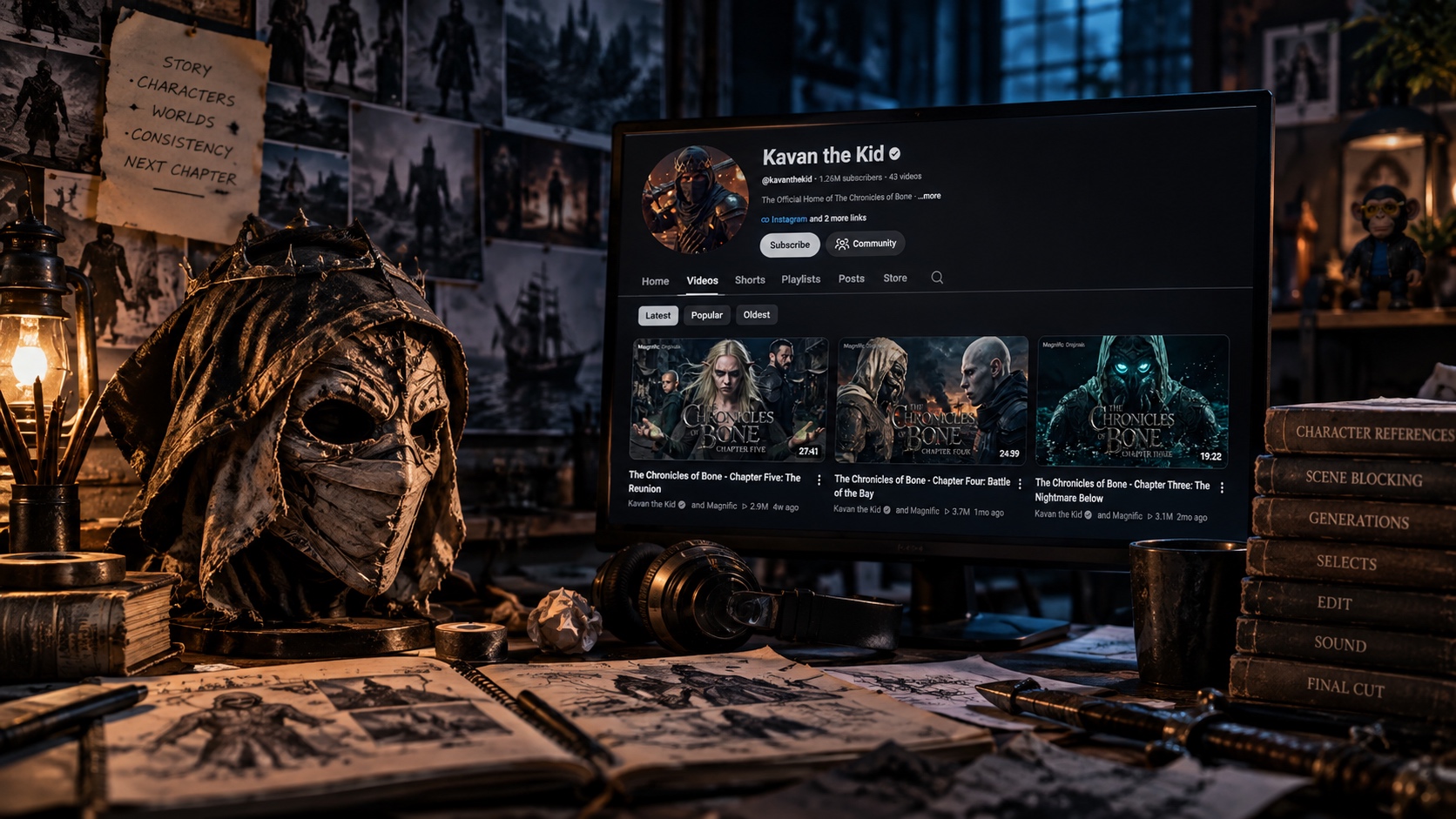
Kavan Cardoza's dark-fantasy series runs on Magnific, Nano Banana 2 and Seedance, but the tool list is the easy part.
The harder question is what keeps characters, locations, voices and story coherent across episodes that can run beyond 20 minutes.
The answer looks less like prompting and more like a compressed filmmaking pipeline: physical references, character sheets, blocking, repeated generation, aggressive rejection, audio repair, editing, grading and sound design.
And the stack is still changing underneath it.
Research verified: September 30, 2026
Evidence note
This article draws on Kavan Cardoza's public statements, Magnific production disclosures, interviews and reporting from Forbes and the Los Angeles Times, plus official documentation from ByteDance and Moises.
Most detailed workflow disclosures come from Cardoza himself or from Magnific, which provides funding, credits, platform access and promotion around the series. They should therefore be treated as first-party production accounts rather than an independent audit.
Choosely has not inspected Cardoza's project files or independently reproduced The Chronicles of Bone workflow.
Where the stack has changed over time, this article says so. Where the evidence does not support a clean answer, the answer remains unknown.
Quick answer: What AI does Kavan the Kid use?
The strongest current evidence places Magnific at the center of The Chronicles of Bone production environment.
For Season 1 Chapter 3, Magnific says Nano Banana 2 created all locations and character reference sheets while Seedance 2.0 handled all video generation.
By August 2026, the workflow was already moving again. Forbes reported newer sequences generated with Seedance 2.5, while other sections of the same broader production still used Seedance 2.0.
Seedance 2.5 also introduced a new problem. Cardoza said unwanted background music appeared in almost every generation, so he used Moises to separate the music from dialogue and effects before rebuilding some damaged sound manually.
Final post-production remains heavily human-led. Cardoza has described editing in Adobe Premiere Pro, color grading in DaVinci Resolve, plus effects, sound and music work.
So the current documented stack is roughly:
Magnific → Nano Banana 2 → Seedance 2.0 / 2.5 → Moises where needed → Premiere Pro / DaVinci Resolve
That is the software.
The production method around it is the more interesting part.
The Chronicles of Bone stack at a glance
| Production job | Tool or method | Evidence |
|---|---|---|
| Story, scripts and show bible | Kavan Cardoza | CONFIRMED |
| Physical character source | Photographed costumes and masks | CONFIRMED |
| Character reference sheets | Nano Banana 2 inside Magnific | CONFIRMED |
| Locations / environments | Nano Banana 2 inside Magnific | CONFIRMED |
| Blocking | Reference images used as placement guides | CONFIRMED |
| Video generation | Seedance 2.0; Seedance 2.5 on newer sequences | CONFIRMED |
| Dialogue / voice | Handled within the Seedance workflow; consistency method undisclosed | STRONGLY SUPPORTED / METHOD UNKNOWN |
| Score | Human-directed / prompt-directed production; current model not named | TOOL UNKNOWN |
| Audio separation | Moises on newer Seedance 2.5 material | CONFIRMED |
| Sound repair / design | Manual | CONFIRMED |
| Effects cleanup | Cardoza, with collaborator help on problem shots | CONFIRMED / SOFTWARE UNKNOWN |
| Editing | Adobe Premiere Pro | CONFIRMED |
| Color grading | DaVinci Resolve | CONFIRMED |
| Production platform | Magnific | CONFIRMED |
| Earlier video generation | Kling and Google Veo / Flow during the prologue era | CONFIRMED, HISTORICAL |
There are several things we are deliberately not putting into the current stack.
After Effects and Blender could not be verified. Suno appears in older secondary reporting, but not strongly enough to call it the current scoring tool.
The stack has already changed
The Chronicles of Bone began its prologue run in November 2025 before moving into Season 1 in May 2026.
Earlier production used a more mixed toolchain. A January 2026 interview focused on Part Two of The Chronicles of Bone discussed workflow decisions across Google Veo / Flow, Nano Banana and other tools, while a separate post Kavan reshared attributed Prologue 2 to both Kling AI and Google DeepMind Veo. By March, Freepik was publicly describing Nano Banana for character design and Kling for video generation across the series. By Season 1, the workflow had shifted again to Nano 2 and Seedance 2.0.
Then Seedance 2.5 arrived.
That progression matters because it challenges an easy conclusion about AI workflows: that the tools are incidental and the production method is entirely model-agnostic.
Cardoza told the Los Angeles Times that he had become heavily dependent on Seedance because of its ability to maintain character consistency between shots.
So the more accurate read is this:
The production functions are durable. The leverage is still model-dependent.
Character references, blocking, editing, rejection and sound repair will survive the next model release.
But Cardoza's ability to produce the series at its current cadence appears to depend heavily on what Seedance can currently do.
The workflow starts with a camera, not a prompt
One of the strangest parts of the production is also one of the most traditional.
Cardoza often begins characters physically.
For the Collector, Forbes reported that he wrapped his face in bandages, added a circular hat and modified raincoat, then photographed himself.
Captain Nemo's mask began as a physical mask made by an artist in Spain. Cardoza says he acquired the rights to it before incorporating the design into the character.
For the Last Lost Boy, the Los Angeles Times documented Cardoza photographing himself wearing a three-faced mask and distressed clothing before those images entered the generative workflow.
The obvious production advantage is specificity.
A real photographed object gives the model something concrete to preserve instead of asking it to invent another broadly familiar fantasy character from scratch.
But there is a second reason this matters.
The physical-reference workflow also appears to be an authorship strategy
Cardoza has spoken publicly about the steps he takes to establish human authorship around the project.
According to Forbes, he says the scripts and show bible have been registered, the title has been trademarked, character designs have been approved and episode copyright applications are pending.
Choosely has not independently checked those claims against Copyright Office records, so they remain attributed to Cardoza.
What can be established is that his production method creates a substantial trail of human contribution.
There are original scripts.
There are physical costume and mask photographs.
There are character designs developed from those references.
There are blocking decisions.
There are edits.
There is color grading.
There is sound work.
Cardoza also says he has been submitting screen recordings of Premiere editing, DaVinci grading, effects, sound and music work as evidence of his own involvement.
That makes the production workflow more than a method for getting better images.
It also creates a record of who did what.
In an AI-heavy production, that may become increasingly valuable.
Nano Banana 2 creates the continuity layer
Once a character design is established, Nano Banana 2 inside Magnific is used to build standardized visual material.
For Season 1 Chapter 3, Magnific says Nano Banana 2 handled all locations and character reference sheets.
That is a different job from generating a beautiful still.
A short AI demo only needs one impressive frame.
A serialized production needs the same character to survive different lenses, lighting conditions, body positions, costumes, locations and conversations without quietly turning into somebody else.
Cardoza's answer is to treat references as production infrastructure.
The same principle applies to environments.
Rooms and ships cannot simply look atmospheric. Their geography has to remain stable between cuts.
That is where blocking references enter the workflow.
For scenes with multiple characters, Cardoza creates an image establishing where each character belongs and instructs Seedance to use it as a placement guide.
Magnific says the method helped maintain spatial logic across larger group scenes.
That sounds simple.
It solves one of the most stubborn problems in generated filmmaking.
The hardest scenes are not necessarily the spectacular ones
Magnific's production notes contain a useful detail.
For Chapter One, it says a long dialogue scene inside the Mordane chamber proved harder than the fight sequence.
Chapter 3's most difficult sequence was reportedly a two-person conversation on a moving ship.
Those scenes are difficult because nothing can hide.
The room has to remain the same room.
The ship has to keep travelling in the same direction.
An over-the-shoulder cut has to preserve the other character's position.
Clothing and faces have to stay stable.
The emotional performance has to survive the cut.
A spectacular generated shot can work on its own.
A conversation exposes whether the production can maintain a world.
That is why continuity may now be a more useful measure of long-form AI video than individual shot quality.
Seedance is doing more than making pretty footage
For Season 1 Chapter 3, Magnific says Seedance 2.0 handled all video generation.
The attraction is not difficult to understand.
The model gives Cardoza a way to animate existing reference systems while maintaining characters and locations across shots.
The newer Seedance 2.5, released by ByteDance on July 31, expands that control.
ByteDance documents single-pass generations of up to 30 seconds and support for up to:
- 30 reference images
- 10 reference videos
- 10 audio clips
That is unusually relevant to serialized filmmaking.
It means a generation can carry far more information about characters, environments, movement and sound than a simple text prompt.
But more control does not remove the selection problem.
About 90 generations for one usable shot
One figure from Forbes changes the economics of the whole story.
During a complex battle sequence generated with Seedance 2.0, Cardoza said he averaged around 90 generations for each usable shot.
That figure applies to one demanding sequence, not every shot in The Chronicles of Bone.
It still matters.
AI can make a generation quickly.
That does not mean it makes the right generation quickly.
The expensive part can become rejection.
Does the face still match?
Did the costume change?
Does the sword behave properly?
Are the background characters coherent?
Did the camera move in the right direction?
Is the performance usable?
Does the shot actually belong beside the shot before it?
The generator produces candidates.
The director still decides which candidate survives.
What does 90 generations actually cost?
We do not know.
That is an important limitation.
Magnific supplies Cardoza with funding, credits, platform access and promotional support. The economics of his production therefore cannot be cleanly transferred to an independent creator paying retail prices.
The 90-generation figure tells us something about production effort.
It does not tell us what an unsponsored creator should budget per finished minute.
This distinction gets lost quickly in AI filmmaking discussions.
Generation can be cheap.
A usable generation may not be.
Seedance 2.5 appears dramatically faster, with one big caveat
Forbes reports that a roughly 12.5-minute battle sequence produced with Seedance 2.0 took around 14 to 16 days.
Newer opening and campfire sequences produced with Seedance 2.5, of roughly comparable combined duration, reportedly took around three days.
That sounds enormous.
It also needs qualification.
The slower footage involved a battle and crowd scenes.
The faster footage involved different types of scenes.
This is therefore not a laboratory comparison in which only the model changed.
It is still evidence of a substantial production improvement.
It is not evidence that Seedance 2.5 makes every type of Chronicles footage five times faster.
No reliable full-episode production time has been disclosed.
A faster video model created a new audio problem
The newer workflow also produced one of the best examples of why an AI upgrade does not automatically simplify an entire production.
Cardoza said Seedance 2.5 was inserting background music into almost every generation.
That was a problem because he wanted control over his own score.
He turned to Moises.
The audio-separation platform can split multimedia audio into dialogue, soundtrack and effects.
Cardoza used it to remove the unwanted music while attempting to preserve the useful dialogue and sound effects.
It did not always work cleanly.
Some useful effects reportedly bled into the music stem and disappeared with it.
Cardoza then rebuilt that sound manually.
There is also a source tension worth preserving.
ByteDance says Seedance 2.5 is designed to reduce uncontrolled background music, while Cardoza says unwanted music appeared in nearly every generation he was making.
Both claims can exist.
The production evidence is what happened in his workflow.
A faster picture model removed one bottleneck and created another one downstream.
Generation speed is not production speed
That distinction is probably the clearest lesson in the entire stack.
Seedance 2.5 appears to have accelerated picture creation.
Then audio became a problem.
Seedance 2.0 could generate useful battle footage.
Then rejection became the problem.
Character generation improved.
Then long conversations and spatial continuity became the problem.
Better AI does not necessarily remove work in a straight line.
Sometimes it moves the work somewhere else.
For an actual production, that matters more than how quickly one impressive clip appears in a demo.
The edit still decides what becomes a film
Magnific says every frame of its Originals is generated using its tools and that final editing happens outside the platform.
Cardoza has documented Premiere Pro editing and DaVinci Resolve grading, as well as effects, sound and music work.
That makes the phrase "AI-generated series" technically useful and operationally incomplete.
A generated reaction may be too long.
The establishing shot may arrive too late.
A convincing creature may still break continuity.
A fight can contain excellent individual clips and still become unreadable if the edit loses screen direction.
Cardoza's earlier workflow description says he generates, animates and edits together, sometimes finishing 30 to 40 seconds of near-final footage before moving further ahead.
That changes the relationship between generation and post.
Editing is not merely where the finished clips are assembled.
It is part of the generation process itself.
Is The Chronicles of Bone really made by one person?
Largely, but not literally.
Cardoza is clearly the central creative operator.
He writes, directs, generates, selects and performs substantial post-production work.
Forbes also reports that Phantom X co-founder Sav sometimes helps clean up effects when generated shots fail.
Magnific supplies funding, credits, platform access and marketing support, while Cardoza retains ownership and creative control under the arrangement described in the reporting.
So "one-person studio" is directionally fair as a description of creative authority.
It can become misleading when used as a description of resources.
This is better understood as a creator-led micro-production with platform and collaborator support.
That is still a dramatic reduction from the crew required to create a conventional serialized fantasy production.
It is not one person operating in a vacuum.
The audience grew with the production
The audience trajectory is substantial even without using an unverified live subscriber count.
Cardoza says his YouTube channel had around 18,000 subscribers when the series began.
The Los Angeles Times reported roughly 500,000 by early July.
By August 18, Forbes described the channel as approaching one million.
Those numbers are dated deliberately because audience metrics change quickly. Current live totals should be rechecked immediately before publication rather than copied forward from a third-party tracker.
The important point is the trajectory.
The series has moved beyond being an AI-filmmaking experiment watched mainly by other AI creators.
It has built a mainstream audience around the story.
Which parts of Kavan's stack could you replace?
Most of them.
Another image model could theoretically replace Nano Banana 2 if it can maintain references well enough.
Premiere can be replaced by another professional editor.
DaVinci is already one of several possible finishing environments.
Moises is solving a particular audio-separation problem that another capable separation system could potentially solve.
The video-generation layer is currently harder to treat as interchangeable.
Cardoza's own comments tie a large part of the production's continuity advantage to Seedance.
And each significant model change has created consequences elsewhere in the pipeline.
That does not mean Seedance will always be essential.
It means "just swap the model" is not currently supported by the production evidence. Choosely's Seedance 2.5 vs Kling 3.0 comparison examines that model choice directly.
What another creator should actually copy
Do not start by copying the subscription list.
Copy the functions.
You need:
- 1A story system
Scripts, character motivations and a reason for the next episode to exist.
- 1A character bible
Stable visual references that define what a recurring character actually is.
- 1Environment references
Rooms, landscapes, ships and recurring sets need a consistent identity.
- 1Blocking
Characters must occupy believable positions relative to one another.
- 1A regeneration budget
Assume many generations will be rejected.
- 1Continuity review
Someone has to catch the reversed ship, changed costume or drifting face.
- 1An audio plan
Generated dialogue and sound may still require separation and reconstruction.
- 1A real edit
Shot order, duration, reaction timing and screen direction are not solved by generation.
- 1A record of human work
This may matter creatively, commercially and legally.
That architecture is more useful than memorizing which model was fashionable in September 2026. For another creator stack built around patient selection and editing, see Promptgenix's workflow.
What remains unknown
Several boxes still do not have responsible answers.
The exact voice-consistency method has not been independently reviewed. Magnific points to a creator session explaining the method, but that source remains unresolved.
The current music-generation tool is not established. Suno appears in older secondary reporting, but not strongly enough to treat it as part of the present stack.
There is no verified episode-wide generation count.
There is no clean full-episode production time.
It is not established that Seedance 2.5 has completely replaced Seedance 2.0.
The software used for effects cleanup has not been responsibly identified.
The exact cost of producing an episode cannot be reconstructed from the public evidence.
And no percentage dividing "human work" from "AI work" would be meaningful enough to publish.
Those gaps stay open.
Choosely's Take
The Chronicles of Bone is interesting because it exposes where the work moves as AI video gets better.
The production is no longer primarily limited by whether a model can create a beautiful fantasy shot.
The difficult parts are increasingly continuity, direction, rejection, repair and editorial assembly.
Physical references give the characters an identity.
Nano Banana 2 standardizes that identity.
Blocking references help preserve geography.
Seedance generates motion and performance.
Dozens of rejected generations may sit behind one accepted shot.
Moises repairs an audio side effect of the newer model.
Premiere and DaVinci turn accepted material into an episode.
That begins to resemble a compressed VFX and editorial pipeline with generation sitting in the middle.
The tempting conclusion is that this production method will survive whatever model comes next.
Only partly.
The functions probably will.
The current leverage is still heavily model-dependent.
Cardoza has said Seedance solved a continuity problem he had struggled with, and moving from Seedance 2.0 to 2.5 appears to have changed both the speed of picture creation and the structure of his sound workflow.
That is the more useful state of AI filmmaking in 2026.
The models are getting better.
The work is not disappearing.
It keeps moving.
Frequently asked questions
What AI does Kavan the Kid use?
The strongest current evidence shows Kavan Cardoza using Magnific as his production platform, Nano Banana 2 for character reference sheets and locations, Seedance 2.0 and 2.5 for video generation, and Moises for separating unwanted generated music on newer Seedance 2.5 material. He also uses Adobe Premiere Pro and DaVinci Resolve in post-production.
Does Kavan the Kid use Seedance?
Yes. Seedance is firmly documented in the current Chronicles of Bone workflow, and Cardoza has described it as particularly important for maintaining characters between shots.
Does Kavan use Seedance 2.0 or Seedance 2.5?
Both appear in recent evidence. Season 1 Chapters 1 and 3 were documented with Seedance 2.0. Forbes later reported Seedance 2.5 being used on newer sequences while other footage still used 2.0.
How does Kavan keep the characters consistent?
He begins some characters with photographs of physical masks, costumes and himself, then builds standardized character reference sheets. Those references are reused during generation. Group scenes can also use blocking-reference images to preserve character placement.
Is The Chronicles of Bone fully AI-generated?
Magnific says every frame of its Originals is generated using its AI production tools, with final editing performed outside the platform. The finished series still involves substantial human writing, direction, selection, editing, grading, effects and sound work.
Does Kavan use Moises?
Yes, in a newer Seedance 2.5 workflow documented by Forbes. He used Moises to remove unwanted model-generated music while trying to preserve dialogue and effects. Some useful sound was lost during separation and rebuilt manually.
How many generations does one episode need?
There is no verified episode-wide total. On one complex Seedance 2.0 battle sequence, Cardoza reported roughly 90 generations per usable shot. That figure should not be generalized to every scene.
How long does a Chronicles of Bone episode take to make?
No reliable full-episode figure has been disclosed. Forbes reported sequence-level production times of around 14 to 16 days for one Seedance 2.0 battle section and around three days for newer Seedance 2.5 opening and campfire material. Those scenes differed, so the numbers should not be treated as a controlled speed comparison.
Does Kavan make The Chronicles of Bone alone?
Cardoza is the central creator and performs most of the work, but not literally all of it. Phantom X co-founder Sav has helped with effects cleanup, while Magnific supplies platform access, credits, funding and promotional support.
Can I make something like The Chronicles of Bone with the same tools?
The broad production method is reproducible. The Best AI Video Generator 2026 guide maps other model options by production job.
The result is not guaranteed by owning the subscriptions.
Character design, continuity, blocking, shot selection, rejection, editing, sound and storytelling remain significant production jobs.
Final takeaway
Cardoza has said he expects today's generated footage to look dated in the years ahead.
That is probably inevitable.
The interesting question is what survives the model cycle.
The current answers are not Seedance 2.0 or Nano Banana 2.
They are the story world, the character designs, the reference system, the production habits, the audience, and the documented human decisions connecting one generation to the next.
For creators studying The Chronicles of Bone, that is the part worth copying.
The model will change.
The production memory should not.
Building a creator workflow of your own? Explore Stack Intelligence to track the tools you rely on and the changes that could affect your production.
The Change Brief
Get the week’s AI changes in one clear read
Pricing moves, tool launches, free-tier changes and practical stack updates, filtered for people who actually use these tools.
Stay ahead of AI without following it all day. We’ll send you what matters each week.
Continue reading
Related reads
AI Tool Recommendations
Inside Promptgenix's AI Music Videos: The Stack Behind the Alien-Blues Visuals
Promptgenix combines generative music, a conventional DAW, AI image creation, image-to-video tools, and patient manual editing in a one-person production workflow.
AI Tool Recommendations
Seedance 2.5 vs Kling 3.0: Which AI Video Model Should You Actually Use?
Seedance 2.5 leads on longer multimodal sequences and localized editing. Kling 3.0 remains the stronger documented fit for native 4K, structured shots, and controlled dialogue.
AI Tool Recommendations
Best AI Video Generator in 2026: Seedance vs Veo vs Kling vs Runway
Seedance, Veo, Kling and Runway can all create impressive AI video, but they solve different production problems. Here is how to choose the right model for your workflow.
Sources
- Forbes: Kavan the Kid builds AI film characters he owns: production stack, timings, Moises, authorship and Magnific relationship.
- Magnific: Season 1, Chapter 3: Nano Banana 2, Seedance 2.0, blocking and music prompting.
- Magnific: Season 1, Chapter One: early Season 1 stack and voice-method reference.
- Magnific: The Chosen Knight: physical references and production method.
- Magnific Originals: platform, release cadence and generated-frame claim.
- Freepik Originals historical Kling disclosure: prologue-era Nano Banana and Kling workflow.
- Delirio AI / Karloff interview with Kavan Cardoza: Part Two discussion of Veo Flow, Nano Banana and voice consistency.
- Kavan-reshared Prologue 2 attribution: Kling AI and Google DeepMind Veo attributed to Prologue 2.
- ByteDance Seed: Seedance 2.5: model capabilities and release.
- Moises: Multimedia Tracks: audio separation capability.
- Los Angeles Times: Seedance and Hollywood: Cardoza interview, physical references and July audience context.
- Creative Bloq: Cardoza interview: filmmaking background and craft perspective.