 CHOOSELY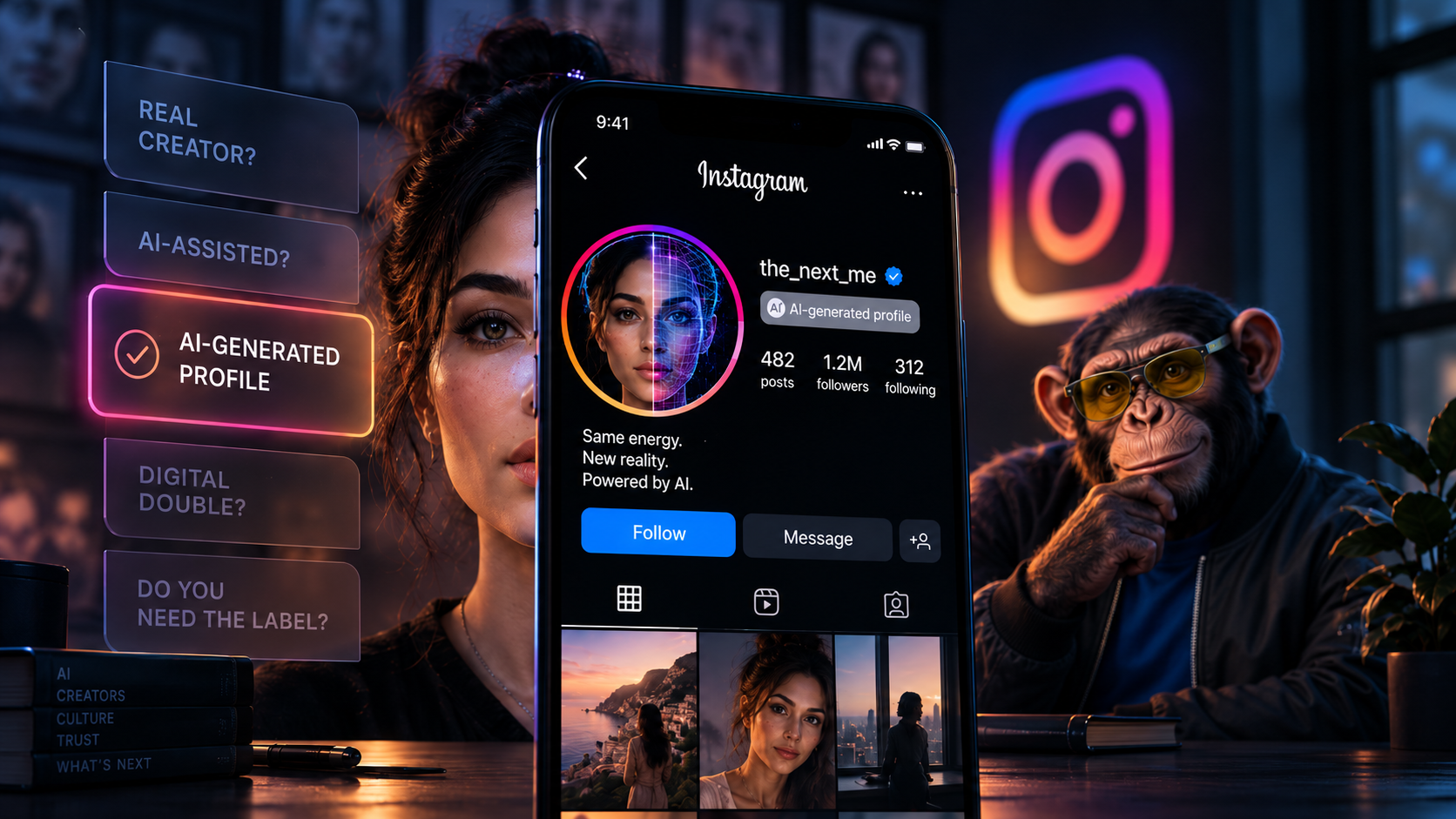
Instagram has changed how it handles profiles built around AI-generated people, and this time there is a distribution consequence attached.
On August 31, Instagram renamed its existing AI creator label to AI-generated profile. The new wording is meant to make it clearer when the person featured by an account is AI-generated rather than human.
Instagram also says profiles that feature an AI-generated person and do not use the label may see limits to their reach. If Instagram identifies one of those profiles, the creator can check Account Status to see whether the account is still eligible to appear in recommendations.
The part most creators need to hear is simpler.
Instagram’s own announcement says creators who simply use AI tools as part of their creative process do not need to add the profile label.
So the practical question is not whether AI touched your workflow. It is whether the identity presented by the profile is an AI-generated person.
For most real creators using AI tools to help make content, the new account-level label is unlikely to be the issue. For profiles built around synthetic people, the disclosure now matters to recommendation eligibility.
What Instagram changed on August 31
Instagram already had an AI creator profile label.
The problem was the name. A label called AI creator could easily describe a human photographer, designer or video creator who happened to use generative tools somewhere in the production process.
The replacement is more specific: AI-generated profile.
Instagram says the label is intended to make it clearer when a profile features an AI-generated person.
That distinction is doing most of the work.
The company also added a consequence for qualifying profiles that remain unlabeled. Instagram says those accounts may see limits to their reach and may become ineligible to appear in recommendations.
Creators who believe Instagram has classified their profile incorrectly can appeal through Account Status. Adding the appropriate label can also restore recommendation eligibility.
Instagram has not published a percentage showing how much reach an affected profile would lose, so claims that the change cuts reach by a fixed amount are not supported by the announcement.
Using AI does not automatically make your profile AI-generated
This is the most useful line in Instagram’s announcement:
Creators who simply use AI tools as part of their creative process do not need to add the new profile label.
That leaves normal AI-assisted creation on the human side of the policy boundary.
The announcement does not publish a detailed checklist naming every permitted editing tool, every caption assistant or every type of generative workflow. That matters. A few reports have supplied their own examples, but Choosely would not turn those examples into Instagram policy.
The first-party rule is broader and safer:
Using AI during the creative process does not, by itself, make the profile an AI-generated profile.
That means the disclosure is aimed at the identity featured by the account rather than every software tool used behind the scenes.
A real creator can use AI.
A real business can use AI.
A human-led production workflow can use generative tools heavily.
The profile-level question is still whether the person being presented by the account is AI-generated.
Who is the label actually for?
The clearest case is a profile centered on a synthetic person.
Think of a virtual influencer, fictional presenter or recurring photorealistic personality whose apparent human identity was generated with AI.
Instagram says the new label is designed to tell viewers when a profile features an AI-generated person. The company says it made the change after hearing from people who disliked finding a profile that appeared human and only later discovering that the featured person was AI-generated.
That makes the trust issue fairly concrete.
The rule is not trying to answer whether AI was used somewhere in production. It is trying to make the identity of the person being followed easier to understand.
Profiles built around obviously fictional or stylized characters may feel less deceptive to viewers, but Instagram’s public announcement does not provide a detailed edge-case matrix for every type of avatar or virtual character.
The grey zone: digital doubles and AI versions of real people
There are easy cases at both ends.
A normal human creator using AI tools during production is covered by Instagram’s explicit creative-process exemption.
A completely synthetic person used as the identity of a profile falls squarely inside the stated purpose of the new label.
The difficult cases sit between them.
A creator might use:
- a photorealistic digital double;
- a recurring AI avatar based on their real appearance;
- a synthetic spokesperson for a brand;
- a heavily altered version of a real person;
- a profile that alternates between the real creator and an AI counterpart.
Instagram’s August 31 announcement does not publish a detailed threshold for those situations.
That is the honest answer.
We would not infer a formal test from secondary reporting or pretend Instagram has drawn a bright line it has not publicly documented.
Creators operating in that middle ground should check Instagram’s current AI-generated profile guidance and Account Status rather than relying on broad social-media advice.
There is now an actual setting to review
The policy is not just theoretical.
Instagram says creators can add the label by editing their profile and switching on AI-generated profile.
The label then appears on the profile and can also appear alongside the creator’s content. If a specific piece of media already carries its own AI disclosure, Instagram does not need to duplicate the same signal in exactly the same way.
There is also a small but important task for people who used the old AI creator label.
Instagram says those creators will see the renamed label and be prompted to review whether it still applies. They can confirm it or remove it if the narrower wording no longer describes their profile.
That is probably the most actionable part of the change for an existing creator.
If you previously turned on AI creator, check the renamed setting rather than assuming Instagram made the decision for you.
What happens if Instagram thinks your profile should be labeled?
Instagram says qualifying profiles it detects may be notified and can review their status through Account Status.
If the account is no longer eligible for recommendations, there are two paths back:
- 1Add the AI-generated profile label if it accurately describes the account.
- 2Appeal if Instagram got the classification wrong.
That appeal path matters because automated detection will not be perfect in every case.
Instagram does not say an unlabeled profile is automatically suspended or deleted simply because of this rule. The documented consequence is about reach and recommendation eligibility.
That distinction is worth preserving.
Losing discovery can be commercially serious for a creator, but it is still different from losing the account itself.
Does using the label hurt your reach?
Instagram says creators who proactively use the AI-generated profile label will not see a change to their profile’s reach simply because they added it.
That gives synthetic-persona creators a straightforward incentive to disclose.
The platform is attaching the distribution risk to qualifying profiles that remain unlabeled, rather than saying AI-generated personalities are unwelcome altogether.
There may still be audience effects. Some followers may react differently once they know a personality is synthetic.
That is a separate question from Instagram’s recommendation policy.
The profile label is different from an AI label on a post
Instagram now has two related ideas that are easy to mix together.
The new AI-generated profile label is about the person featured by an account.
Meta also uses AI info labels on individual pieces of content when its systems detect that media was generated or edited using AI, or when someone discloses that themselves.
Meta reaffirmed that approach in 2026. It says it uses industry signals and technologies such as C2PA to identify AI-generated or AI-edited content and provide transparency labels.
The two labels therefore answer different questions.
AI-generated profile: Who is the person this account presents?
AI info on content: What role did AI play in creating or editing this particular media?
Instagram’s August 31 announcement also connects the systems directly: once the profile label is enabled, it can appear alongside the account’s content unless that piece of media already has its own AI label.
What this means for normal AI-assisted creators
Most creators do not need to redesign their workflow because this label exists.
Instagram has explicitly left room for people to use AI tools during creative work without declaring the entire profile AI-generated.
That is important because mixed workflows are becoming normal.
A creator might use one tool to brainstorm, another to generate an image, another to edit it, and a conventional editor to finish the post.
Choosely’s own AI image-generator guide shows how specialized these workflows have become. Different tools now handle product photography, typography, artistic direction, local generation and vector work. None of that automatically answers the identity question Instagram is asking.
The practical line is simpler:
If the profile belongs to a real human or organization that uses AI tools, ordinary AI assistance does not automatically trigger the new account-level label.
If the person people are following is AI-generated, review the setting.
If the account sits in the digital-double grey zone, check current Instagram guidance instead of guessing.
A simple creator decision guide
| Profile situation | What the current guidance supports |
|---|---|
| Real creator who uses AI tools in the creative process | The profile label is not required simply because AI is used |
| Real business using generative tools for content | AI use alone does not make the profile AI-generated |
| Profile centered on an AI-generated person | Review and use the AI-generated profile label |
| Existing user of the old AI creator label | Review the renamed setting and confirm or remove it |
| Digital double or mixed real/synthetic identity | Public guidance is less specific. Check Instagram’s current help guidance |
| Instagram classifies the profile incorrectly | Use Account Status and appeal |
Choosely verdict
Instagram’s new rule is narrower than the headlines make it sound.
For ordinary creators, the important fact is that using AI tools during the creative process does not automatically make a profile AI-generated.
The new disclosure is aimed at a different problem: accounts where the person being presented to the audience is AI-generated.
For those creators, the label now matters because recommendation eligibility is tied to disclosure. Instagram gives correctly labeled profiles a clear route to remain recommendable, while creators who are wrongly classified can appeal through Account Status.
There are still grey areas around digital doubles and mixed identities, and Instagram’s public announcement does not resolve every one of them.
That is where we would resist inventing certainty.
For now, the practical move is straightforward: review the identity your profile presents, not every AI tool used to make the posts.
Keep up with the AI changes that affect your workflow
AI tools are changing quickly, and the platforms around them are changing too.
The Change Brief filters the product, pricing, access and platform changes that are worth knowing into one weekly read.
You can also explore Choosely’s latest AI-tool analysis, comparisons and workflow guides at Choosely.ai.
FAQ
Do I need the AI-generated profile label because I use AI tools?
Not simply because you use AI. Instagram says creators who use AI tools as part of their creative process do not need to add the profile-level label for that reason alone.
Who is the AI-generated profile label meant for?
Instagram says it is intended for profiles that feature an AI-generated person. The goal is to make it clearer when the person presented by the account is AI-generated rather than human.
Can an unlabeled AI-generated profile lose reach?
Yes. Instagram says qualifying profiles that do not use the label may see limits to their reach and may lose recommendation eligibility.
What if Instagram gets the classification wrong?
Instagram directs creators to Account Status. They can appeal the decision if they believe their profile was incorrectly classified.
Primary sources
- Instagram Creators: Bringing More Transparency to AI-Generated Profiles on Instagram
- Instagram Help Center: About AI-generated profile labels on Instagram
- Meta: How Meta Is Preparing for the 2026 US Midterm Elections
Secondary context only:
The Change Brief
Get the week’s AI changes in one clear read
Pricing moves, tool launches, free-tier changes and practical stack updates, filtered for people who actually use these tools.
Stay ahead of AI without following it all day. We’ll send you what matters each week.
Continue reading
Related reads
AI Creator Workflows
How Is Yang Mun Made? The AI Tools Behind the 2.5M-Follower AI Monk
HeyGen is the only tool clearly verified at the center of Yang Mun's current workflow. Choosely separates the documented stack from plausible but unconfirmed claims.
AI Tool Recommendations
Best AI Image Generator in 2026: Match the Tool to the Job
There is no universal best AI image generator. These five specialist picks match product shots, infographics, artistic direction, local deployment and vector work.
AI Creator Workflows
Inside Promptgenix's AI Music Videos: The Stack Behind the Alien-Blues Visuals
Promptgenix combines generative music, a conventional DAW, AI image creation, image-to-video tools, and patient manual editing in a one-person production workflow.
Product Update
Claude's Invisible Watermark Is Real. The Panic Is Ahead of the Facts
Claude text watermarking is now active across multiple current models worldwide, but a watermark is provenance evidence rather than proof of authorship or personal identity.